
Is Semi-Annual or Annual HVAC Maintenance Worth the Cost in Arizona? A Homeowner's Guide
Homeowners across Scottsdale, Phoenix, Mesa, Chandler, Queen Creek, Paradise Valley, and Fountain Hills ask the same question every year:
"Is HVAC maintenance actually worth paying for, or is it just another service companies try to sell?"
It is a fair question.
After all, if the air conditioner is cooling and the heater is heating, why spend money on maintenance?
The answer depends on how a homeowner views HVAC ownership. There are essentially two strategies:
Reactive maintenance: Run the equipment until something breaks.
Proactive maintenance: Inspect, clean, adjust, and repair small issues before they become major failures.
Both approaches will eventually result in repair bills and equipment replacement. The difference is how much control the homeowner has over the timing and cost.
For most Arizona homeowners, especially those dealing with extreme summer temperatures, proactive maintenance almost always delivers a better return on investment.
The Arizona Reality
HVAC systems in Arizona operate under some of the harshest conditions in the country.
A typical air conditioner in Scottsdale or Phoenix may run 2,500 to 4,000 hours per year. During July and August, many systems operate almost continuously throughout the afternoon.
That constant workload creates wear on:
- Capacitors
- Contactors
- Fan motors
- Compressor components
- Electrical connections
- Condensate systems
- Blower assemblies
- Air filtration systems
Every one of these components gradually degrades over time.
The question is not whether they will fail.
The question is whether the failure is identified while it is still a $150 issue or after it becomes a $2,500 issue.
Understanding Reactive Maintenance
The reactive approach sounds appealing because it appears to save money.
The strategy is simple:
"If it is working, leave it alone."
Many homeowners successfully follow this strategy for years.
Then one of two things happens:
Scenario 1: The Emergency Breakdown
It is 4:30 PM on a Saturday in July.
Outdoor temperature is 113 degrees.
The air conditioner stops cooling.
Now the homeowner needs:
- Emergency service
- After-hours labor
- Potentially expedited parts
- Immediate repairs without time to compare options
The homeowner has lost all negotiating leverage because comfort has become an emergency.
Scenario 2: Small Problems Become Large Problems
A capacitor weakens.
The homeowner notices nothing.
The compressor starts harder every day.
Weeks later, the compressor fails.
The original repair may have cost a few hundred dollars.
The resulting repair may cost several thousand dollars.
This is the hidden cost of reactive maintenance.
Most major HVAC failures begin as small, inexpensive issues.
Regular inspections are designed to catch those issues early.
Understanding Proactive Maintenance
Proactive maintenance follows the same philosophy used for vehicles.
Most people do not wait for an engine seizure before changing oil.
They perform routine maintenance because replacing an engine is expensive.
HVAC equipment operates similarly.
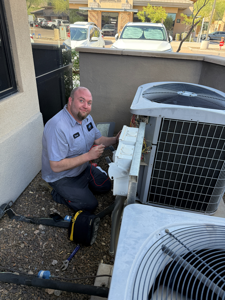
During a maintenance visit, technicians inspect components, verify performance, clean critical surfaces, and identify developing issues before they become catastrophic failures.
Examples include:
- Weak capacitors
- Loose electrical connections
- Dirty condenser coils
- Restricted evaporator coils
- Refrigerant performance issues
- Worn contactors
- Drain line restrictions
- Blower wheel contamination
- Airflow deficiencies
Most of these problems are relatively inexpensive when identified early.
Many become expensive when ignored.
Annual Maintenance vs. Semi-Annual Maintenance
This is where the discussion becomes more nuanced.
Not every home requires the same maintenance schedule.
Annual Maintenance
Annual maintenance typically includes one comprehensive inspection and tune-up each year.
For homeowners who:
- Occupy the home part-time
- Have newer equipment
- Use the system lightly
- Maintain filters consistently
Annual maintenance may be adequate.
A yearly inspection provides an opportunity to identify developing issues and verify proper operation before peak demand occurs.
Many manufacturers recommend regular maintenance as part of warranty requirements.
Semi-Annual Maintenance
Semi-annual maintenance includes two visits per year:
- Spring cooling inspection
- Fall heating inspection
This approach is generally considered the gold standard for residential HVAC systems. Many HVAC professionals recommend servicing cooling equipment before summer and heating equipment before winter.
For Arizona homeowners, semi-annual maintenance provides several advantages:
- More frequent inspection of wear items
- Better coil cleanliness
- Earlier detection of electrical failures
- Verification of heating operation before cold weather
- Improved system efficiency throughout the year
Given the extreme cooling demand in the Valley, semi-annual maintenance often provides the strongest long-term value.
The Economics of Small Repairs
One of the biggest misconceptions surrounding HVAC maintenance is that maintenance prevents all repairs.
It does not.
Equipment still ages.
Parts still wear out.
Maintenance simply changes when problems are discovered.
Consider a hypothetical example:
Option A: Proactive Repair
During a spring inspection, a technician identifies:
- Weak capacitor
- Pitted contactor
Repair cost:
- Approximately a few hundred dollars
System continues operating normally.
Option B: Reactive Repair
The homeowner declines maintenance.
The capacitor fails during a July heat wave.
The compressor struggles during repeated startup attempts.
Emergency service is required.
Potential cost:
- Diagnostic fee
- After-hours labor
- Component replacement
- Possible compressor damage
The difference is not merely repair cost.
The difference is avoiding collateral damage.
Many expensive HVAC failures begin with inexpensive components.
Energy Efficiency Matters
Maintenance is not solely about preventing breakdowns.
It is also about operating efficiency.
Dirty coils, restricted airflow, failing motors, and clogged filters force HVAC systems to work harder.
When equipment works harder:
- Energy consumption increases
- Utility costs increase
- Component wear accelerates
According to multiple HVAC industry sources, regular maintenance can improve efficiency and reduce unnecessary energy consumption by keeping equipment operating closer to its intended design parameters.
In Arizona, where cooling costs represent a significant portion of household utility bills, even modest efficiency improvements can accumulate over time.
The Lifespan Question
Most homeowners focus on repair costs.
Few focus on replacement timing.
A residential HVAC system may represent a $10,000 to $25,000+ investment depending on system size, efficiency level, ductwork requirements, and installation complexity.
If maintenance helps extend equipment life by even a few years, the financial benefit can be substantial.
Routine maintenance reduces wear and helps identify operational problems before they create widespread damage. Multiple industry sources cite extended equipment lifespan as one of the primary benefits of preventative maintenance.
Think of it this way:
A maintenance plan is not competing against the cost of doing nothing.
It is competing against:
- Earlier system replacement
- Higher energy costs
- Emergency repair premiums
- Reduced comfort
- Increased downtime
Indoor Air Quality Benefits
Arizona homeowners spend a significant amount of time indoors during summer.
Maintenance can also improve indoor air quality by addressing:
- Dirty blower assemblies
- Contaminated evaporator coils
- Restricted filters
- Airflow deficiencies
A cleaner HVAC system generally distributes cleaner air and operates more effectively.
This becomes particularly important for households with:
- Allergies
- Asthma
- Pets
- Young children
- Elderly occupants
What Maintenance Does Not Do
A reputable HVAC company should be transparent about this.
Maintenance is not magic.
Maintenance cannot:
- Prevent all failures
- Reverse aging equipment
- Eliminate future repairs
- Guarantee indefinite system life
Anyone promising those outcomes is overselling.
What maintenance does provide is risk reduction.
It improves the odds that:
- Problems are discovered early
- Systems operate efficiently
- Repairs remain smaller
- Equipment lasts longer
- Emergencies become less frequent
That is a practical and realistic expectation.
When Annual Maintenance Makes Sense
Annual maintenance may be sufficient if:
- Equipment is less than five years old
- The homeowner changes filters consistently
- The system operates lightly
- The property is occupied seasonally
- No history of recurring repairs exists
In these situations, one comprehensive inspection each year may provide an acceptable balance between cost and risk.
When Semi-Annual Maintenance Makes Sense
Semi-annual maintenance is generally recommended when:
- Equipment is over five years old
- The home is occupied full-time
- Summer cooling demand is high
- Pets are present
- Dust levels are elevated
- Prior repair history exists
- Reliability is a high priority
This describes a large percentage of homes in Scottsdale, Phoenix, Mesa, Chandler, Queen Creek, Paradise Valley, and Fountain Hills.
In these cases, the additional inspection often pays for itself through early issue detection and improved performance.
Smart Thermostats and Monitoring
Modern HVAC technology has made proactive maintenance even more effective.
Smart thermostats can help identify operational anomalies before homeowners notice comfort issues.
Examples include:
- Excessive runtime
- Temperature swings
- Abnormal cycling patterns
- Connectivity alerts
Popular options include:
While these products do not replace professional maintenance, they can provide valuable visibility into system performance.
The Real Question
The question is not whether maintenance costs money.
It does.
The real question is whether homeowners prefer predictable costs or unpredictable costs.
Reactive maintenance generally creates:
- Larger repair events
- More emergency calls
- Greater inconvenience
- Higher financial volatility
Proactive maintenance generally creates:
- Smaller repairs
- Better planning
- Improved efficiency
- Greater reliability
- Longer equipment life
Neither approach eliminates expenses.
One simply provides more control.
Final Verdict: Is Semi-Annual or Annual Maintenance Worth It?
For most homeowners in Scottsdale, Phoenix, Mesa, Chandler, Queen Creek, Paradise Valley, and Fountain Hills, HVAC maintenance is worth the investment.
Annual maintenance is often sufficient for newer systems with lighter usage.
Semi-annual maintenance is typically the better choice for full-time Arizona residents because cooling systems operate under extreme conditions for much of the year. Industry guidance commonly recommends professional inspections before both cooling and heating seasons, particularly for systems that provide year-round comfort.
The most expensive repair is often not the biggest repair.
It is the repair that could have been prevented.
A loose wire becomes a burned contactor.
A weak capacitor becomes a compressor problem.
A dirty coil becomes years of elevated utility bills.
Maintenance is not about fixing what is broken.
It is about finding what is about to break.
Frequently Asked Questions About HVAC Maintenance
Q: How often should an HVAC system be serviced in Arizona?
Most HVAC professionals recommend servicing residential HVAC systems at least once per year. However, because air conditioning systems in Scottsdale, Phoenix, Mesa, Chandler, Queen Creek, Paradise Valley, and Fountain Hills operate under extreme summer conditions, many homeowners benefit from semi-annual maintenance.
A spring inspection prepares the cooling system for summer demand, while a fall inspection verifies heating performance and identifies developing issues before winter.
Q: Is HVAC maintenance really necessary if the system is working?
Yes.
Many HVAC failures develop gradually and show no obvious symptoms until a breakdown occurs. Weak capacitors, loose electrical connections, restricted airflow, and dirty coils can often be identified during routine maintenance long before they cause comfort issues.
Maintenance is designed to identify small problems before they become expensive repairs.
Q: What is included in a professional HVAC maintenance visit?
While service procedures vary by contractor, a typical maintenance visit may include:
- Checking refrigerant performance
- Testing capacitors and electrical components
- Inspecting contactors and relays
- Tightening electrical connections
- Cleaning condenser coils
- Inspecting evaporator coils
- Verifying airflow
- Checking blower performance
- Flushing condensate drains
- Testing thermostat operation
- Inspecting heating components
- Measuring system temperatures
The goal is to verify safe, efficient, and reliable operation.
Q: Does HVAC maintenance reduce energy bills?
It can.
Dirty coils, clogged filters, airflow restrictions, and worn components force HVAC systems to work harder. Routine maintenance helps keep equipment operating closer to manufacturer specifications, which can improve efficiency and reduce unnecessary energy consumption.
Q: Is semi-annual maintenance better than annual maintenance?
For many Arizona homeowners, yes.
A system that runs heavily during long summers experiences more wear than systems in milder climates. Semi-annual maintenance provides two opportunities each year to identify developing issues, clean critical components, and verify system performance.
Older systems and heavily used systems generally benefit the most from twice-yearly inspections.
Q: Can HVAC maintenance prevent all repairs?
No.
Even well-maintained equipment eventually requires repairs as components age and wear out.
The purpose of maintenance is not to eliminate repairs. The purpose is to reduce the likelihood of major failures, identify developing issues earlier, and help equipment operate more reliably.
Q: How long should a residential HVAC system last in Arizona?
System lifespan varies based on installation quality, usage, maintenance, and operating conditions.
Many systems in Arizona experience shorter lifespans than systems in cooler climates because of the intense cooling demand. Regular maintenance can help maximize equipment life and delay costly replacement.
Q: What happens if maintenance is skipped?
Skipping maintenance increases the risk of:
- Unexpected breakdowns
- Higher utility bills
- Reduced cooling capacity
- Poor airflow
- Component failures
- Shortened equipment life
While some systems may operate for years without maintenance, many expensive repairs begin as small issues that routine inspections would have identified.
Q: Is HVAC maintenance worth it for newer systems?
Yes.
Newer systems can still develop electrical issues, airflow problems, drain restrictions, or installation-related concerns. Regular maintenance helps ensure the system continues operating as designed and may also support manufacturer warranty requirements.
Q: What is the biggest benefit of HVAC maintenance?
Reliability.
Most homeowners do not think about their HVAC system until it stops working. Routine maintenance helps reduce the likelihood of unexpected breakdowns during the hottest days of the Arizona summer, when repair demand is highest and comfort becomes a priority.
Hello, I am Andy Pasterchick, owner of Varsity Zone HVAC of Scottsdale. I proudly serve our community with honest, high-quality HVAC services throughout Scottsdale, Phoenix, Paradise Valley, and the surrounding areas. This guide helps Arizona homeowners determine whether annual or semi-annual HVAC maintenance provides enough value through improved reliability, lower repair costs, greater efficiency, and longer equipment life to justify the investment.