
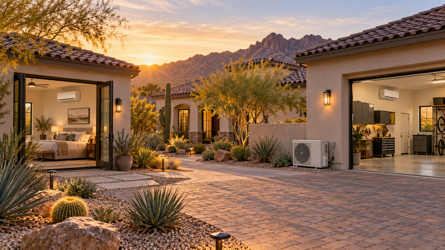
Hello, I am Andy Pasterchick, owner of Varsity Zone HVAC of Scottsdale. October is when the Valley starts to fill back up. Winter visitors are coming home, family is booking flights for the holidays, and the casita that sat empty and stuffy all summer is suddenly about to become a guest suite again. It is also when homeowners finally get around to the garage project they put off while it was too hot to stand in there. That is why we field so many questions this time of year about a ductless mini split in Scottsdale for spaces the main AC system was never designed to reach.
The question we hear most is simple. Is a mini split a good option for a casita or a garage? For most homes, yes, and often it is the best option available. In this post I will explain why, where a mini split shines, where it needs some help, and what a quality installation should include so the system you pay for actually keeps up when the heat returns next summer.
The Short Answer for Casitas, Garages, and Additions
A ductless mini split is built for exactly the kind of space that gives central air conditioning trouble. A detached casita, a guest room over the garage, a converted garage, or a new addition all share one problem. They sit at the far end of your duct system, or they have no ducts at all. Running new ductwork out to them is expensive, disruptive, and often disappointing once it is done.
The ENERGY STAR program specifically lists additions and outbuildings such as garages as good candidates for mini splits, particularly where extending ductwork or heating and cooling capacity is difficult. It also calls out rooms next to unconditioned space, like a guest room above a garage, where ducts would be exposed to harsher temperatures. If you have ever walked into a bonus room on a July afternoon and felt like the AC was barely trying, you already understand that problem.
There are a few situations where a mini split needs more planning, such as an uninsulated garage or a casita with a lot of west-facing glass. We will get to those. But for the large majority of Scottsdale homeowners asking about a separate space, a properly sized mini split is the practical answer.
How a Ductless Mini Split Works in a Scottsdale Home
A mini split has two main parts. An outdoor unit holds the compressor and condenser, and one or more indoor units, often called heads, sit inside the room and deliver the conditioned air. The two are connected by a small bundle of refrigerant tubing, power wiring, and a condensate drain line.
According to the U.S. Department of Energy, connecting the indoor and outdoor units generally requires only about a three-inch hole through the wall, and the outdoor unit can sit up to 50 feet from the indoor unit. That flexibility matters on Scottsdale lots, where you may want the condenser tucked beside the casita, behind a garden wall, or along a side yard rather than next to the pool deck.
Indoor heads come in several styles. The most common is a slim wall-mounted unit high on the wall. There are also ceiling cassettes that sit flush in the ceiling, floor consoles that work well under a window, and concealed ducted units that hide in a soffit or closet and feed short duct runs to one or two rooms. The Department of Energy notes that most wall units are only about seven inches deep, so they do not take over the room.
Each indoor head has its own controls, which means the casita can be set to one temperature while the main house holds another. When nobody is staying in the guest space, you can set it back and stop paying to cool an empty room.
Why the compressor matters in desert heat
Most modern mini splits use an inverter-driven compressor. Instead of slamming on at full power and shutting off, an inverter compressor speeds up and slows down to match the load. The Building America Solution Center at Pacific Northwest National Laboratory explains that most ductless heat pumps can run down to roughly 30 percent of their rated capacity, which avoids much of the energy lost to frequent starting and stopping.
In practical terms, that means steadier temperatures and quieter operation. On a mild October evening the system hums along at low speed. On a scorching afternoon next August it ramps up. The room stays closer to the setting you chose instead of swinging warm, then cold, then warm again.
Why Extending Your Central Ductwork Often Falls Short
When a homeowner adds a room or finishes a garage, the first instinct is often to tie it into the existing system. Sometimes that works. Often it does not, for a few reasons we see across the Valley.
First, your current system was sized for the house as it was built. Adding several hundred square feet of conditioned space to a system that already runs nonstop in July means everything gets a little warmer, not just the new room.
Second, the new space is usually at the end of the longest duct run. By the time air travels through the attic to reach it, it has picked up heat along the way. The Department of Energy reports that duct losses can account for more than 30 percent of energy used for space conditioning, especially when ducts run through unconditioned space like an attic. In a Scottsdale attic during summer, that is a very real concern.
Third, a casita is usually a separate building entirely. Running insulated ducts underground or across a courtyard is rarely worth the cost or the comfort you get from it.
A mini split sidesteps all three issues. It adds its own dedicated capacity, it delivers air directly into the room, and it needs only a refrigerant line rather than a duct run. PNNL's code brief notes that ductless heat pumps are often used for additions precisely because they eliminate the need to extend ductwork into the new space.
Mini Splits for Casitas and Guest Houses
Casitas are part of the character of Scottsdale homes, from older properties near McCormick Ranch to newer builds with a detached guest suite off the courtyard. Many were built with a small through-the-wall unit or a window unit, or they were tied into the main house system and never quite kept up.
A mini split makes a lot of sense for a casita, especially with snowbird season starting. Here is why.
Independent control. Guests can set their own temperature without touching the main house thermostat, and you can turn the casita down when it is empty.
Quiet operation. The noisy compressor lives outside. Inside, guests hear a soft fan instead of a rattling wall unit, which makes a real difference in a bedroom.
Heating and cooling in one system. Most mini splits are heat pumps, so the same unit that cools the casita in summer warms it on cool winter nights.
A cleaner look. A wall head or ceiling cassette replaces the box hanging out of a window and gives you that window back.
If your casita has a bedroom, a bathroom, and a small living area, the layout will drive the design. Sometimes one well-placed head can cover an open studio. A casita with a separate bedroom often needs two heads so the bedroom does not depend on air making its way around a corner and through a doorway. ENERGY STAR makes this point directly, noting that it can be challenging for heat to move through an open doorway and impossible through a closed one.
Timing a casita project for fall
Fall is a smart time for this work. Our schedule is far more flexible than it is in June, the weather is pleasant enough to work comfortably on rooftops and exterior walls, and you have time to get the system in before winter visitors arrive or holiday guests need the space. If you are hosting family from Thanksgiving through New Year's, starting the conversation in October gives you plenty of runway.
Cooling a Garage in the Valley Heat
Arizona garages get brutally hot. A closed garage on a summer afternoon can feel hotter than outside, because the sun bakes the roof and the garage door and the heat has nowhere to go. That is a problem if you use the space as a workshop, a home gym, a hobby room, or just want to load the car without breaking a sweat.
A mini split is one of the few cooling options that genuinely works in a garage. Window units are rarely possible, portable units struggle badly in our heat, and tying a garage into your home's central system is a bad idea. Garages hold car exhaust, fuel, and chemicals, and you do not want that air pulled back into your living space through shared ductwork. A mini split keeps the garage on its own system with no air exchange with the house.
Insulation comes first
Here is where honesty matters. A mini split can only do so much in a space that is built like an oven. Many Scottsdale garages have uninsulated walls, an uninsulated ceiling or roof deck, and a thin metal garage door that soaks up afternoon sun. Put a properly sized mini split in that space and it may still run all day without getting the room as cool as you want.
Before we size a garage system, we look at what is between you and the outdoors. Adding insulation to the garage door, sealing gaps around it, and insulating the ceiling can dramatically reduce the load. Sometimes a smaller, less expensive system will do the job once those upgrades are in place. We would rather tell you that up front than sell you an oversized unit that fights a losing battle.
Converting a garage to living space
If you are turning a garage into a bedroom, office, or rental space, that is a different project than simply cooling a workshop. PNNL's code brief notes that when an unconditioned space like a garage is altered to become conditioned space, it is generally expected to be brought into compliance with the energy code. In plain terms, a true garage conversion usually involves insulation, air sealing, and permits, not just adding an air conditioner. Your city's building department has the final word on what is required, so a conversion is worth planning with your contractor and permit office from the start.
Room Additions, Converted Spaces, and Problem Rooms
Mini splits are not just for separate buildings. They solve a lot of everyday comfort problems inside the main house too.
New additions. A family room, primary suite, or sunroom added to an existing home is a classic mini split application.
Bonus rooms over the garage. These rooms are surrounded by heat on several sides and are often the hottest spaces in a two-story home.
Home offices. If you work from home, a dedicated head lets you keep your office comfortable during the day without cooling the whole house to the same level.
The one room that never keeps up. A west-facing bedroom or a room at the end of a long duct run can be handled with a single head rather than replacing the entire central system.
ENERGY STAR notes that mini splits can serve as whole-home systems but are also a great fit to supplement an existing HVAC system. If your central system is in good shape but one area always lags, adding a mini split for that area can be far more cost-effective than upsizing everything.
If your main system is aging and you are considering replacing it anyway, it is worth discussing both projects together. Sometimes the right answer is a new central system plus a mini split for the outlier space. Our heat pump team can walk you through how those options fit together.
Sizing and Placement Decisions That Make or Break Comfort
Mini splits have a reputation for being efficient and comfortable, and they earn it when they are designed well. When they are not, homeowners end up disappointed. Most of the problems we are called to fix come down to sizing and placement.
Bigger is not better
It is tempting to assume a larger unit will cool faster and handle the Arizona heat better. The Department of Energy warns that oversized or poorly placed indoor units lead to short cycling, which wastes energy and fails to provide proper temperature or humidity control. An oversized system also costs more to buy and to operate.
The right size comes from a load calculation, not a rule of thumb. ENERGY STAR advises that contractors verify system size using Manual J, the industry calculation for how much heating and cooling a space actually needs. That calculation accounts for square footage, ceiling height, insulation, windows, sun exposure, and how the space is used. A garage gym with a west-facing door and a casita bedroom shaded by a courtyard wall will come out very differently even at the same square footage.
Where the indoor head goes
Placement inside the room affects how evenly it cools. A head should be able to throw air across the main living area without blowing straight onto a bed or desk. ENERGY STAR also notes that cool air sinks and warm air rises, which affects which areas a single wall unit will actually reach. In tall-ceiling casitas or rooms with lofts, that is worth planning around.
Where the outdoor unit goes
Outside, the condenser needs space to breathe. ENERGY STAR recommends unobstructed airflow and avoiding tight spots against shrubs or structures, along with thinking about service access. In Scottsdale we also think about afternoon sun, reflected heat from block walls, and how close the unit sits to a neighbor's bedroom window. A condenser jammed into a narrow side yard against a hot wall works harder than it needs to.
Line sets and drainage
The refrigerant lines and condensate drain need a clean, protected route. PNNL's code brief notes that condensate must go to an approved place of disposal and that refrigerant suction lines should be insulated. In our climate, insulation on outdoor line sets breaks down in the sun if it is not protected, so we pay attention to covers and line set routing. Done well, the installation looks tidy and holds up for years. Done poorly, you get drips on the stucco and insulation that cracks and falls off after a couple of summers.
Single Zone or Multi Zone
A single-zone system is one outdoor unit paired with one indoor head. It is the simplest and often the most efficient choice for a single room, a garage, or a studio-style casita.
A multi-zone system connects several indoor heads to one outdoor unit. The Department of Energy notes that many models support up to four indoor units on one outdoor unit, each with its own thermostat. That can work well for a casita with a bedroom and a living area, or for a group of rooms in an addition.
There are tradeoffs. One outdoor unit means less clutter outside, but it also means every zone depends on that one unit. In some homes, two single-zone systems make more sense than one multi-zone system, especially when the spaces are far apart or used very differently. A garage workshop and a guest casita, for example, have very different schedules and loads, and we often recommend keeping them on separate systems.
This is a design decision that should come from looking at your property, not from a sales sheet. If you are curious how a mini split could pair with app-based controls, we can also talk through smart thermostat and control options during the visit.
Heating on Chilly Desert Nights
People forget that Scottsdale gets cold. Winter nights regularly drop into the 40s, and a detached casita with no heat source can feel downright chilly for a guest who flew in from somewhere warmer than they expected the desert to be.
Because most mini splits are heat pumps, the same system that handles summer cooling also provides winter heat. ENERGY STAR points out that mini splits deliver both heating and cooling from one system and that, because they move heat rather than generate it, certified models use up to 60 percent less energy than standard electric radiators. If your casita currently relies on a plug-in space heater or an old electric wall heater, a mini split is usually a big step up in comfort and in operating cost.
ENERGY STAR also recommends picking a steady temperature with a heat pump rather than turning it way down and back up, and setting the system to heat or cool rather than auto on days when the weather swings. Those small habits help a mini split run at its best through our mild winters.
Permits, Code, and What a Good Installation Looks Like
A mini split is a real piece of HVAC equipment with refrigerant lines, high-voltage wiring, and a condensate drain. It should be installed with the same care as a central system, and new installations generally go through the city permit process. Handling permits is part of how our team approaches installations, so you are not left sorting out paperwork on your own.
PNNL's code brief describes what inspectors typically look for on a ductless heat pump installation. Those items include proper labeling and mounting, correct thermostat and control setup, insulated refrigerant piping, proper condensate disposal, and locking caps on outdoor refrigerant access ports to prevent tampering. Those are good benchmarks for any homeowner. If a quote does not mention permits or treats the installation like a weekend project, ask more questions.
A good installation should include the following.
A load calculation for each space, not a guess based on square footage alone.
A clear plan for indoor and outdoor unit locations that you agree with before work begins.
Line set routing that is protected from sun and looks clean on the exterior.
A condensate drain that discharges to an appropriate spot, not onto a walkway or against your foundation.
Startup testing and a walkthrough of how to use the remote or app.
Keeping a Mini Split Healthy Through Dust and Monsoon Season
Mini splits need less maintenance than many people expect, but they are not maintenance free, especially here. Our dust, monsoon storms, and summer heat are hard on any outdoor equipment.
Indoor heads have washable filters behind the front panel. ENERGY STAR recommends cleaning them when they look dirty or when the filter light comes on. In a dusty Scottsdale garage or workshop, that may be every few weeks during heavy use. In a guest casita that is only occupied part of the year, a check before guests arrive and again before summer is a good habit.
Beyond the filters, the indoor coil and blower wheel can collect dust and buildup over time, and the outdoor coil gets coated with dirt and debris after monsoon season. A professional cleaning keeps airflow strong and helps prevent odors and drainage issues. That is exactly the kind of work our Season Ticket Maintenance Plan is built for, so your mini split gets regular attention alongside the rest of your system.
How to Choose a Mini Split Installer in Scottsdale
Mini splits are widely available, and that means quality varies a lot from one installer to the next. ENERGY STAR recommends shopping for a well-regarded contractor who is familiar with ductless systems. Here are a few things I would look for if I were in your shoes.
They visit the space. A real quote comes after someone has looked at the casita, garage, or addition, checked insulation and sun exposure, and talked with you about how you use it.
They explain sizing. Ask how they arrived at the size they are recommending. You should get a clear answer, not a shrug.
They talk about placement with you. Where the head goes inside and where the condenser goes outside are your home and your view. You should have a say.
They address permits. A professional installer will be clear about permits and inspections.
They plan for service. Ask what maintenance looks like and who you call if something goes wrong.
My background before founding Varsity Zone HVAC of Scottsdale was in the medical device industry, and before that I served in the U.S. Army. Both taught me that precision and follow-through are not optional. We bring that same approach to every installation. We would rather spend extra time on design and placement than come back later to fix a system that was rushed. You can learn more about how we approach these projects on our ductless mini split installation page.
Frequently Asked Questions About Ductless Mini Splits in Scottsdale
Is a mini split a good option for a casita or garage?
Yes, for most homes. Mini splits are designed for spaces where extending ductwork is difficult, and ENERGY STAR lists additions and outbuildings such as garages as strong candidates. Garages usually need insulation upgrades first so the system is not fighting an oven.
How much does a ductless mini split cost in Scottsdale?
Cost depends on the number of indoor heads, the size of each zone, the distance between the indoor and outdoor units, electrical work, and the style of indoor unit you choose. A single-zone garage system and a two-zone casita system are very different projects. The most reliable way to get a number is an in-person assessment and a written quote.
Can one mini split cool an entire casita?
Sometimes. An open studio casita can often be handled by one well-placed head. A casita with a separate bedroom usually needs a second head, since conditioned air does not travel well through doorways or around corners.
Will a mini split keep up with 110-degree summer days?
A properly sized and installed mini split can keep a well-insulated space comfortable through Valley summers. Sizing is the key. That is why a load calculation for the specific space matters more than square footage alone.
Do mini splits provide heat in winter?
Most do. Mini splits are typically heat pumps, so the same system cools in summer and heats on cool winter nights. ENERGY STAR notes certified models use up to 60 percent less energy than standard electric radiators.
How often should a mini split be serviced?
Clean the washable indoor filters whenever they look dirty, which can be often in a dusty garage. Professional service on a regular schedule keeps the coils, blower, and drain clear, especially after monsoon season.
Get Your Casita, Garage, or Addition Ready This Fall
If you have a casita that needs to be guest-ready, a garage you want to use year-round, or a room that never keeps up, now is a great time to plan a mini split. Varsity Zone HVAC of Scottsdale serves homeowners across Scottsdale, Paradise Valley, Fountain Hills, Tempe, Mesa, and Phoenix. Contact our All-Star Team to schedule a visit, and we will help you find the right fit for your space before winter guests arrive.