
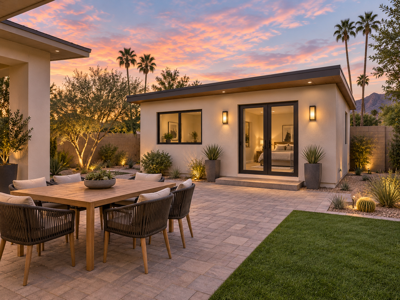
Hello, I am Andy Pasterchick, owner of Varsity Zone HVAC of Scottsdale. I proudly serve our community with honest, high-quality HVAC services throughout Scottsdale, Phoenix, Paradise Valley, and the surrounding areas. This article is written for Valley homeowners who are building a casita, finishing a garage, or enclosing a patio, and who need to decide how that new space will be cooled.
A home’s central air conditioning is meant to be sized for the house on the drawings: a load calculation sets the capacity, and the ductwork serves the rooms that existed when the system went in. A backyard casita, a garage turned into a gym or workshop, and a patio enclosed as an Arizona room were not on those drawings. Each adds heat that the original system was not sized to remove, and each raises the same question: what should cool the new space, and what should not.
A change in state law has put that question in front of more Valley homeowners. Arizona House Bill 2720, adopted on May 21, 2024, and codified at A.R.S. § 9-461.18, requires every city and town with more than 75,000 residents to allow at least one attached and one detached accessory dwelling unit, or ADU, on lots where a single-family home is allowed. In a February 2026 report by The Arizona Republic, reprinted by Scottsdale REALTORS®, Queen Creek Mayor Julia Wheatley said the town has had more than 850 ADUs since 2015, and the report found that the City of Phoenix had issued 398 ADU certificates of occupancy since 2024.
The National Weather Service office in Phoenix counted 70 days at or above 110°F in 2024, the most on record; whatever cools the new space has to hold up through days like those. The sections below cover the casita, the garage, and the Arizona room in turn, and end with the questions to put to any contractor, including us.
What the Casita Law Allows, City by City
The statute sets a floor, and several cities go beyond it. A covered city must permit an ADU of up to 75 percent of the main home’s gross floor area or 1,000 square feet, whichever is less. It may not require additional parking, may not prohibit the main home or the ADU from being used as separately leased long-term rental housing, and may not set side or rear ADU setbacks greater than five feet. The statute does not supersede building codes, fire codes, or public health and safety regulations; heating and cooling fall under those codes, so easier zoning does not make a casita’s mechanical design any less important.
Each city and town in our service area applies the law, or its own guest-house rules, in its own way:
- Phoenix permits two ADUs on a lot with one single-family home, and a third under certain circumstances, each up to 75 percent of the primary dwelling’s gross floor area, not to exceed 1,000 square feet on lots up to 10,000 square feet or 3,000 square feet on larger lots.
- Scottsdale allows one attached and one detached ADU per single-family property under Ordinance 4687, adopted on September 30, 2025. The first ADU may not exceed the lesser of 1,000 square feet or three-quarters of the main residence’s size, and a second or third, where allowed, may not exceed 500 square feet.
- Tempe permits one attached and one detached ADU, up to 1,000 square feet on lots under one acre and up to 2,000 square feet on lots of one acre or more, in each case no larger than 75 percent of the main home’s interior habitable floor area.
- Mesa allows an attached and a detached ADU on any property with an existing single residence, each capped at 1,000 square feet or at three-quarters of the primary dwelling’s habitable floor area, whichever is smaller. Its building permit plan set includes electrical, plumbing, and mechanical plans, and its preapproved housing design program accepts ADU plans at 200, 600, and 1,000 square feet.
- Chandler permits one detached and one attached ADU by right; its January 2025 chart of rules for detached residential buildings requires an ADU to be served by the same water, sewer, and electric utility providers and meters as the primary residence.
- Queen Creek publishes an ADU FAQ for homeowners and codifies its rules in Article 6.1.D of its zoning ordinance.
- Fountain Hills permits guest houses in its single-family districts under Section 10.02 of its zoning ordinance, provided that a guest house is not used for commercial or nonresidential purposes and is not owned separately from the principal building.
- Paradise Valley requires a separate building permit application for each structure, including a guest house, and a separate mechanical permit to install or replace heating, ventilation, and air conditioning equipment.
One distinction runs through these codes: a guest house and an ADU are not the same thing, and Scottsdale draws the line most clearly. A Scottsdale guest house cannot be rented, is limited to 50 percent of the main residence, and must share utilities with the main home; an ADU may be rented and must be separately metered. The label on the permit governs how the space may be used, and that use sets what its cooling system must do.
Tempe’s ADU guidance, citing local builders, puts the average cost of a high-quality ADU in Tempe at $180,000 to $260,000. The cooling system is the part of that budget that determines whether the space can be used from June through September.
Why the Main System Is the Wrong Place to Start
The tempting shortcut is to extend the house system: a branch duct across the attic for an attached room, or a larger outdoor unit to carry a detached one. The Air Conditioning Contractors of America describes its Manual J as the national ANSI-recognized standard for producing equipment sizing loads and states that a proper load calculation is required by national building codes and most state and local jurisdictions. That calculation sized the existing system for the existing house; adding a casita, a garage, or an Arizona room adds load without adding capacity, and on the hottest afternoons every room shares the shortfall.
ENERGY STAR lists additions and outbuildings, including sheds, barns, and garages, among the situations in which ductless systems are increasingly used, because extending ductwork or heating and cooling capacity to them is difficult. Extending the house system can work in one narrow case: a habitable room attached to the house, where a load calculation shows that the existing equipment has capacity to spare and the ductwork can carry the added airflow. A detached casita is not that case, and a garage is governed by separate code provisions discussed below.
Scottsdale adds a second reason to give a casita its own system. The city’s amendments to the 2021 International Residential Code require every dwelling to have cooling able to hold habitable rooms, bathrooms, and toilet rooms at or below 85°F at a summer design temperature of 107°F, and heating able to hold them at or above 68°F at a winter design temperature of 34°F; cooking appliances and portable space heaters do not count toward the heating requirement. An ADU is a self-contained dwelling unit, so a Scottsdale casita needs both, and a heat pump provides both from one system.
Sizing a Casita for the Valley’s Actual Summers
A pre-approved plan settles the architecture but not the cooling load, because a plan drawn once for an entire city does not know which way a given lot faces, how much of the casita’s glass looks west, or whether a neighboring two-story home shades it in the afternoon. A Manual J calculation accounts for those variables, and the manual includes a section on fenestration load procedures and another on a home addition with a large area of south-facing glass. A casita built from a pre-approved plan still needs its own load calculation for its own lot.
Capacity beyond the calculated load does not buy a safety margin. SRP warns that a unit too large for a home can lead to expensive energy bills and to short cycling, which occurs when an oversized system cools the home quickly instead of gradually. ENERGY STAR states that an oversized air conditioner costs more to purchase, wastes energy, and does not provide better cooling, and that it can cool a room before it has a chance to remove the humidity, leaving the room feeling damp and clammy.
Phoenix’s all-time high, according to the National Weather Service, is 122°F, set on June 26, 1990. Manufacturers publish outdoor operating ranges, and the ranges differ: Daikin lists −13°F to 115°F for its ATMOSPHERA and AURORA single-zone heat pumps and −5°F to 122°F for its OTERRA line. Ask for the published range of every unit you are quoted, and compare it with the spot where the outdoor unit will sit.
ENERGY STAR’s installation guidance for ductless systems reminds homeowners that heat rises and cool air sinks when judging how much of a home a single wall unit will serve. Daikin’s ADU guidance recommends a multi-zone system, with individual control in each room, for any ADU larger than a studio that needs heating or cooling in both a living room and a separate bedroom. A casita with a bedroom door that closes at night generally needs an indoor unit on each side of that door.
The Options, Ranked for Valley Use
The options below are ranked by how well they suit Valley casitas, garages, and Arizona rooms.
Ductless Mini-Split Heat Pump
A ductless mini-split pairs an outdoor unit with one or more indoor units, usually mounted high on a wall, connected by refrigerant lines rather than ducts. ENERGY STAR describes the arrangement as a replacement for window units for cooling, with the same equipment providing heat in winter. For a casita the advantages match the problem: the system operates independently of the main house, serves one room or several, and puts no ductwork in an attic or across a yard. Daikin’s guidance stresses independent operation for rentals and extended-family living, noting that a separate system allows separate temperature settings and billing.
At the top of the category, Bosch rates its Climate 5000 ductless system, which uses R-454B refrigerant, at up to 27.4 SEER2, and Daikin rates its R-32 ATMOSPHERA at up to 27.4 SEER2. Lennox positions its mini-split line for single rooms, small apartments, and other spaces where ductwork is not practical. Trane states that its dealers install, maintain, and repair Mitsubishi Electric mini-split systems, describes mini-split air conditioners as quieter and more efficient than window or through-the-wall units, and lists attached and detached garages, room additions, and backyard sheds among the places they make sense. Varsity Zone also carries equipment from AC Pro, an HVAC distributor whose catalog includes mini-split systems and their accessories.
Mini-splits carry trade-offs as well: each closed room generally needs its own indoor unit, the indoor units are visible, and Trane acknowledges that some homeowners do not care for their appearance. Installation is not a do-it-yourself project; Trane notes that only licensed technicians can handle the refrigerant lines and that a self-installation will likely void the warranty. With proper maintenance, Trane states, most ductless systems last 15 years or more.
Ducted Mini-Split or Small Split System
A larger casita, such as the 2,000-square-foot units Tempe allows on lots of an acre or more, can justify a small ducted system of its own: a compact air handler in a closet or soffit feeding short duct runs inside the conditioned space, where the ducts are not exposed to attic heat. Lennox offers medium-static and high-static ducted indoor units in its mini-split line. For a casita with a conventional attic, a small split-system heat pump is another route; Goodman publishes variable-speed, inverter-driven, side-discharge heat pumps rated up to 19.0 SEER2. Any duct that must run through an attic should be sealed with mastic or metal tape and insulated, as ENERGY STAR’s duct guidance advises.
Extending the Main System
Extension fits only the narrow case described earlier, an attached habitable room with confirmed spare capacity; it is rarely practical for a detached casita, and the code rules it out for a garage.
Window and Through-Wall Units
Room air conditioners are self-contained units that mount in a window or a wall opening. ENERGY STAR publishes a sizing table for them, from 6,000 BTU per hour for 150 to 250 square feet up to 18,000 for 700 to 1,000, with 10 percent more capacity for a very sunny room and 600 BTU per hour for each regular occupant beyond two. The table assumes an eight-foot ceiling, and ENERGY STAR notes that an improperly installed room unit leaks as much air as a six-square-inch hole. These units suit an occasionally used workshop or storage garage better than a living space.
Portable Units
A portable air conditioner on wheels is the simplest option and the most temporary. Phoenix exempts portable and plug-in cooling equipment from mechanical permits. The city’s rental cooling standard, however, calls for permanently installed cooling facilities in rental housing, and a portable unit does not meet that description.
Evaporative Cooling
The University of Arizona Cooperative Extension describes evaporative coolers as commonly used and very effective for cooling homes in southern Arizona’s semi-arid climate. The Phoenix standard for rental housing draws a line between the two technologies: rental units must be capable of reaching 86°F where they are cooled by evaporative cooling and 82°F where they are cooled by air conditioning. For a garage workshop, an evaporative cooler can be a reasonable choice; for a casita meant to be lived in or rented, refrigerated air meets the stricter standard.
Garages: What the Code Allows
The garage is the one space where the code answers the main question directly. Section M1601.6 of the International Residential Code, in both the 2021 and 2024 editions, states that furnaces and air-handling systems that supply air to living spaces shall not supply air to or return air from a garage. Section M1602.2 prohibits taking return air from a garage, with an exception that allows a dedicated forced-air system serving only the garage to draw its return air from the garage. Section R302.5.2 requires ducts in the garage, and ducts passing through the walls or ceilings that separate the garage from the house, to be built of at least No. 26 gage sheet steel or other approved material, with no openings into the garage.
The reasoning behind those provisions is practical: a garage holds vehicles, fuel, and equipment, and the Centers for Disease Control and Prevention warns never to run a car or truck inside a garage attached to a house, even with the garage door open. A return opening in a garage would draw that air into every room the system serves. A supply or return register cut into a garage from the house system violates these provisions; it should be removed and the opening properly closed.
That leaves three sound approaches for a garage used as a gym, workshop, or hobby space:
- A ductless mini-split serving only the garage; ENERGY STAR, Trane, and Daikin all list garages among the spaces these systems suit.
- A dedicated ducted system serving only the garage, which the return-air exception in Section M1602.2 expressly allows.
- A window or through-wall unit, for occasional use in a workshop or storage garage.
Insulation decides how much of any of these a garage needs. The load calculation counts every wall, ceiling, and door, so insulating the garage door and the ceiling below the attic before the calculation reduces the load the equipment must be sized to meet. Workshops also generate dust; ENERGY STAR advises cleaning a ductless unit’s filters whenever they are visibly dirty or the filter light comes on, and our recent article on filtration covers what filters can and cannot do about fine dust.
Arizona Rooms: Settle the Code Question First
Maricopa County’s building directive on sunrooms groups the Arizona room with enclosed patios and sunrooms. The cooling answer depends on whether the room behind the sliding door is a patio with walls added or a permitted, habitable room.
Where an Arizona room began as a patio cover, the original structure was not built as living space. The International Residential Code’s Appendix AH, which Scottsdale adopts, states in Section AH101.2 that patio covers shall be used only for recreational, outdoor living purposes and not as carports, garages, storage rooms, or habitable rooms. Maricopa County’s directive states, as a general rule, that an enclosed patio, Arizona room, or sunroom directly open to adjoining habitable space shall meet the requirements of a habitable space. Tempe’s handout on converting a patio cover to living area states that a building permit is required before the conversion and asks for mechanical locations on the floor plan.
Those rules set the order of work: if the room will be used as living space, the conversion is permitted first, the walls, roof, and glass are brought up to the standard of a habitable room, and only then is the cooling sized and installed. Installing equipment in an enclosure that was never permitted as living space leaves the underlying permit problem in place.
A load calculation accounts for each window’s size, orientation, and glazing, which is why the calculation, not the floor area, should set the equipment size for a room built largely of glass. For a permitted conversion, a ductless mini-split is usually the cleanest fit, because the room rarely has ductwork of its own and the main system was not sized for it.
Power, Meters, and the Outdoor Unit
A casita’s electrical arrangement depends on the city, and it shapes the cooling system:
- Scottsdale requires the property owner to provide separately metered electrical and gas utility connections to an ADU.
- Chandler’s shared-meter rule puts the casita’s cooling load on the main home’s electrical service.
- Mesa allows an ADU to have separate meters or sub-meters for water, sewer, and electricity, with permits.
- Tempe refers owners to their utility provider’s requirements for metering.
Whichever rule applies, the electrical panel and service must have room for the new equipment, and the electrical design should be settled with the casita’s plans rather than after its walls are closed. Daikin notes that some low-amperage mini-splits, such as its OTERRA 115-volt models, can run on a typical 115-volt circuit.
The statute caps ADU side and rear setbacks at five feet, so a casita may sit close to a property line with little room beside it for an outdoor unit. ENERGY STAR’s guidance for ductless outdoor units calls for unobstructed airflow, away from tight placements against shrubs and structures, and for a location that allows service access. Homeowners in associations should also confirm whether the outdoor unit needs architectural review; Tempe and Mesa both note that CC&Rs can restrict ADUs beyond what city rules require.
If the Casita Will Be Rented
Renting the casita turns its cooling system into a legal obligation. Under A.R.S. § 33-1324, an Arizona landlord must maintain in good and safe working order the heating, ventilating, and air-conditioning facilities supplied, and must supply reasonable air-conditioning or cooling where such units are installed and offered, when required by seasonal weather conditions.
Phoenix’s rental cooling standard goes further, requiring every rental housing unit with cooling installed to be capable of cooling all habitable rooms, bathrooms, and toilet rooms to no more than 82°F with air conditioning or 86°F with evaporative cooling, measured three feet above the floor in the center of the room, using permanently installed cooling facilities. Tempe’s ADU guidance states that ADUs must also comply with the city’s Rental Housing Code. A casita intended for rent should be designed to those standards from the start.
Owner-residency and short-term rental rules also vary by city. Scottsdale requires the property owner to reside on the premises for any ADU that is rented, leased, or occupied as a vacation or short-term rental; Tempe requires the owner to live on site when an ADU built on or after December 20, 2024 is licensed as a short-term rental; and Mesa requires a short-term rental license when a unit is rented for 29 days or fewer at a time.
Rebates and Credits in 2026
SRP customers may qualify for the Cool Cash rebate, which pays $225 per ton for an inverter-driven mini-split heat pump rated 15.2 SEER2 or higher, up to $1,125. The program’s published terms decide most casita, garage, and Arizona room cases:
- The mini-split rebate applies to heat pumps; SRP lists no rebate for a cooling-only mini-split.
- Installations in garages and other non-habitable spaces, window units, and new construction homes do not qualify.
- The new system must replace or supplement an existing central heat pump or central air conditioner, must be listed in the AHRI directory, and must be installed before April 30, 2027 by a contractor licensed in Arizona to install residential air-conditioning systems.
- The application must be submitted within six months of installation.
A heat pump mini-split serving a habitable room in an existing home, such as a permitted Arizona room conversion, matches those terms most directly. Whether a newly built casita qualifies depends on how SRP applies its exclusion for new construction; SRP’s program partner, the Electric League of Arizona, answers questions at (602) 264-3108.
The federal credit has expired: the IRS states that the Energy Efficient Home Improvement Credit, which allowed up to $2,000 a year for qualified heat pumps, applies to improvements made through December 31, 2025, so equipment installed in 2026 does not qualify, whatever older product pages still say.
Permits, Licenses, and the Questions to Ask
Mesa’s ADU permit submittal includes mechanical plans, and Phoenix’s list of work exempt from permits covers portable equipment and in-kind replacement of outdoor units of five tons or less at one- and two-family homes, not new installations. The Arizona Registrar of Contractors puts the licensing point plainly: anyone can pretend to be a contractor, so check the license. Varsity Zone HVAC of Scottsdale’s license, ROC 356531, can be verified the same way.
Before signing for cooling in a casita, garage, or Arizona room, ask the contractor for each of the following:
- A Manual J load calculation for the space, on your lot, with your orientation and glass.
- The equipment’s efficiency rating, AHRI reference number, and published outdoor operating range.
- A plan for every room with a door that closes, showing which indoor unit serves it.
- The outdoor unit’s location, with room for airflow and service, and an answer on whether your HOA must approve it.
- The electrical plan: which panel, which meter, and what electrical work the price includes.
- The permits the job requires, and who will pull them.
- A written answer on SRP Cool Cash eligibility before you count on the rebate.
- The maintenance schedule, including filter cleaning, and what the warranty requires.
Plan Before the First 110-Degree Day
The National Weather Service puts Phoenix’s average first 110-degree day at June 11, based on 1991 through 2020. A casita designed this fall, permitted over the winter, and built in the spring can have its cooling in place before that date. A garage or Arizona room project moves faster but follows the same order: the code question first, the building envelope second, the load calculation third, and the equipment last.
Varsity Zone’s fall offer provides a $1,000 credit toward a qualifying new HVAC system, plus two maintenance visits, for qualifying systems installed by October 31, 2026; terms apply. Ask whether your project qualifies when you request a quote.
Frequently Asked Questions About Cooling Casitas, Garages, and Arizona Rooms
Q: Can I build a casita on my lot in the Valley?
A: In most Valley cities, yes. Arizona law, A.R.S. § 9-461.18, requires every city and town with more than 75,000 residents to allow at least one attached and one detached accessory dwelling unit on lots where a single-family home is allowed, at up to 75 percent of the main home’s gross floor area or 1,000 square feet, whichever is less. Phoenix, Scottsdale, Tempe, Mesa, Chandler, and Queen Creek publish ADU rules of their own, and Fountain Hills and Paradise Valley regulate guest houses under their own codes. Check your city’s rules and your HOA’s CC&Rs before the design is drawn.
Q: Can I connect my garage to my home’s central air conditioning?
A: No. Section M1601.6 of the International Residential Code states that furnaces and air-handling systems that supply air to living spaces shall not supply air to or return air from a garage, and Section M1602.2 prohibits taking return air from a garage. The code’s exception allows a dedicated forced-air system that serves only the garage. A ductless mini-split or a dedicated ducted system serving only the garage meets the rule; a register cut into the garage from the house system does not, and it should be removed and the opening properly closed.
Q: What size mini-split does a casita need?
A: The size should come from a Manual J load calculation for the casita on its own lot, not from its square footage alone. The Air Conditioning Contractors of America describes Manual J as the national ANSI-recognized standard for producing equipment sizing loads; the calculation accounts for orientation, glass, insulation, and shading. Bigger is not safer: SRP warns that an oversized unit can lead to expensive energy bills and short cycling, and ENERGY STAR states that an oversized air conditioner costs more to purchase, wastes energy, and does not provide better cooling.
Q: Can one mini-split cool a casita with a separate bedroom?
A: Usually not well; Daikin’s ADU guidance recommends a multi-zone system, with individual control in each room, for any ADU larger than a studio that needs heating or cooling in both a living room and a separate bedroom. A multi-zone system pairs one outdoor unit with an indoor unit in each room, so a bedroom with its door closed at night still has its own source of cooling and its own control.
Q: Is a mini-split or a window unit better for a garage gym?
A: For a garage used regularly, a mini-split is the better choice. Trane describes mini-split air conditioners as quieter and more efficient than window or through-the-wall units, and lists attached and detached garages among the places they make sense. A window or through-wall unit can serve an occasionally used workshop or storage garage, provided it is installed correctly; ENERGY STAR notes that an improperly installed room unit leaks as much air as a six-square-inch hole. Insulating the garage door and ceiling before the load calculation reduces the size of whatever equipment is chosen.
Q: Can I put a mini-split in my Arizona room?
A: Yes, once the room is permitted as living space. The International Residential Code’s Appendix AH, which Scottsdale adopts, states that patio covers shall not be used as habitable rooms, and Maricopa County’s directive on sunrooms states, as a general rule, that an enclosed patio, Arizona room, or sunroom directly open to adjoining habitable space shall meet the requirements of a habitable space. Tempe’s patio conversion handout requires a building permit before the conversion. With the permit in place and the walls, roof, and glass brought up to the standard of a habitable room, a ductless mini-split sized by a load calculation is usually the cleanest fit.
Q: Does SRP give a rebate for a mini-split in a casita or garage?
A: Not for a garage; for a casita, it depends. SRP’s Cool Cash rebate pays $225 per ton for an inverter-driven mini-split heat pump rated 15.2 SEER2 or higher, up to $1,125, but it excludes installations in garages and other non-habitable spaces, window units, and new construction homes. The system must replace or supplement an existing central heat pump or central air conditioner, be listed in the AHRI directory, and be installed before April 30, 2027 by a contractor licensed in Arizona. Whether a newly built casita qualifies depends on how SRP applies its exclusion for new construction; the Electric League of Arizona answers program questions at (602) 264-3108.
Q: Is there still a federal tax credit for heat pumps in 2026?
A: No. The IRS states that the Energy Efficient Home Improvement Credit, which allowed up to $2,000 a year for qualified heat pumps, applies to improvements made through December 31, 2025. Equipment installed in 2026 does not qualify, even where an older product or program page still describes the credit.
Q: Will a mini-split keep working when it is 115°F or hotter outside?
A: That depends on the model, so ask before you buy. Manufacturers publish outdoor operating ranges, and they differ: Daikin lists −13°F to 115°F for its ATMOSPHERA and AURORA single-zone heat pumps and −5°F to 122°F for its OTERRA line. The National Weather Service lists Phoenix’s all-time high as 122°F, set on June 26, 1990, and counted 70 days at or above 110°F in 2024. Compare the published range of every unit you are quoted with the spot where its outdoor unit will sit.
Q: Does my casita need its own electric meter?
A: That depends on the city. Scottsdale requires the property owner to provide separately metered electrical and gas utility connections to an ADU. Chandler requires an ADU to be served by the same water, sewer, and electric utility providers and meters as the primary residence. Mesa allows separate meters or sub-meters with permits, and Tempe refers owners to their utility provider. Whatever the rule, the electrical panel and service must have room for the cooling equipment, and the electrical plan should be settled with the casita’s design.
Q: If I rent my casita, what cooling am I required to provide?
A: Under A.R.S. § 33-1324, an Arizona landlord must maintain the heating, ventilating, and air-conditioning facilities supplied in good and safe working order, and must supply reasonable air-conditioning or cooling where such units are installed and offered, when required by seasonal weather conditions. In Phoenix, the rental cooling standard requires rental units with cooling installed to be capable of cooling habitable rooms, bathrooms, and toilet rooms to 82°F with air conditioning or 86°F with evaporative cooling, using permanently installed cooling facilities. Scottsdale also requires the property owner to reside on the premises when an ADU is rented, leased, or used as a short-term rental.
Q: How long does a mini-split last, and what maintenance does it need?
A: Trane states that most ductless systems last 15 years or more with proper maintenance. ENERGY STAR advises cleaning a ductless unit’s filters whenever they are visibly dirty or the filter light comes on; in a dusty garage workshop, check them often. Refrigerant work belongs to a licensed technician, and Trane notes that a self-installation will likely void the warranty. For scheduled service, ask about our Season Ticket Maintenance Plan.
Hello, I am Andy Pasterchick, owner of Varsity Zone HVAC of Scottsdale. I proudly serve our community with honest, high-quality HVAC services throughout Scottsdale, Phoenix, Paradise Valley, and the surrounding areas. These questions come up whenever a homeowner plans a casita, a garage conversion, or an Arizona room; the answers below accompany our article, Casitas, Garages, and Arizona Rooms: How to Cool the Space Your Central AC Was Never Sized For.
Varsity Zone HVAC of Scottsdale designs and installs ductless mini-split systems for casitas, garages, and Arizona rooms in Scottsdale, Paradise Valley, Fountain Hills, Phoenix, Tempe, Mesa, Chandler, and Queen Creek. To schedule a load calculation for your space, call our office at 480-590-4647 or book online.