
A Valley home inspection report gives the air conditioner a few lines in a long document, yet no other system decides as directly whether the house can be lived in from June through September. Under its 1991 through 2020 normals, the National Weather Service puts Phoenix at an average of 21 days a year at or above 110°F, with the first such day arriving, on average, on June 11; in 2024, Phoenix set the record with 70 such days.
The Buyer Advisory that Arizona REALTORS® and the Arizona Department of Real Estate provide to home buyers, revised in February 2026, addresses the system in two sentences: “Make sure the cooling and heating systems are adequate. If it is important to you, hire a qualified heating/cooling inspector.” That advice reflects a limit built into every standard home inspection in Arizona: the inspector is not required to judge whether the cooling is adequate. The sections below explain what the state’s inspection standard covers, what it leaves out, why Valley homes widen the gap, and how to close it within the contract’s inspection period.
What the Arizona Inspection Standard Requires
Arizona certifies home inspectors through the Board of Technical Registration, and the Board’s rule, R4-30-301.01, requires them to follow the Standards of Professional Practice adopted by the Arizona Chapter of the American Society of Home Inspectors on October 27, 2023. The standards describe a home inspection as “visual, not technically exhaustive.”
For cooling, an inspector must observe the installed equipment, its normal operating controls, the distribution system, and the air filters, and must note whether each habitable space has an installed source of cooling. The inspector describes the energy source, the type of equipment, and the type of distribution, then operates the system with its normal operating controls. Heating follows the same pattern and adds the automatic safety controls and the chimneys, flues, and vents of fuel-burning equipment.
An inspection performed to that standard can find real problems: a system that will not start, a filter that is missing or clogged, a room without a supply register, a visibly damaged duct, or equipment that does not respond to the thermostat. Those findings come from operating the system and looking at it; the standard leaves several larger questions to someone else.
What the Standard Leaves Out
Across its general limitations and its system-by-system sections, the standard lists what an Arizona home inspector is not required to do. For a buyer weighing the air conditioning, the most consequential exclusions are these:
- Observe the uniformity or adequacy of cool-air or heat supply to the various rooms.
- Calculate the strength, adequacy, or efficiency of any system or component.
- Report on life expectancy, or predict future conditions, including the failure of components.
- Determine the age of a component, or distinguish original construction from later additions, replacements, or renovations.
- Report on product recalls, conformance with manufacturers’ installation instructions, or compliance with codes.
- Project operating costs, or report the methods, materials, and costs of corrections.
- Operate heating or cooling when weather conditions or other circumstances may cause equipment damage, or operate a system that is shut down.
- Walk on the roofing, or enter an attic when the access is obstructed, the clearance is less than a nominal 16 by 24 inches, entry could damage the property, or dangerous conditions are suspected.
None of this reflects poorly on inspectors. The standard defines a general inspection of the entire house, from the roof and structure to the plumbing and electrical systems, and an inspector who follows it is doing the job correctly. The same rule that adopts the standard also bars an inspector from performing, or offering to perform, for an additional fee, any repair to a property that the inspector or the inspector’s firm inspected, and from holding any financial interest in that work, for 24 months after the inspection. When a report recommends further evaluation by a qualified HVAC contractor, that recommendation is the inspector’s handoff, and the buyer should act on it within the inspection period.
Why the Gap Is Wider in the Valley
Four conditions found throughout the Valley place more of the cooling system beyond what the inspector is required to examine.
The inspection may take place in mild weather
A home that goes under contract between October and April is inspected under a cooling load far below what the system will carry in July. An air conditioner that holds the house at 75°F on an 80°F afternoon has shown that it runs, and little more; it has not shown what it will do with 110°F outside and afternoon sun on a west wall. A failing compressor, a low refrigerant charge, a dirty coil, or a system too small for the house can pass a mild-weather operating check and still fall behind on the first hot afternoon of the following summer. On a cool morning, the inspector may not run the cooling at all, a situation addressed in the questions at the end of this article.
The equipment may be on the roof
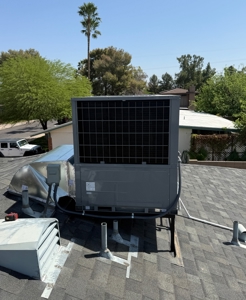
Many Valley homes carry a package unit on the roof, with the compressor, both coils, and the blower in a single cabinet. The standard does not require the inspector to walk on the roofing or to perform any procedure that may damage the property, so a rooftop unit may be viewed only from a ladder at the eave or from the ground. The cabinet’s interior, the coils, the condensate drain, the duct connections through the roof, and the stand or curb beneath the unit are the parts a buyer most needs examined, and they are the parts least likely to be seen.
The air handler and ducts may be in the attic
Where a split system’s air handler or furnace sits in the attic, the evaporator coil, the condensate drain, and most of the ductwork are there with it. The standard excuses the inspector from entering an attic when access is obstructed, when the clearance is too small, or when entry could damage the property or be dangerous, and moving insulation is outside the inspector’s required scope. An inspector who reports the attic from the hatch for one of those reasons, and states the method used, is following the standard.
ENERGY STAR estimates that in a typical house about 20 to 30 percent of the air that moves through the duct system is lost to leaks, holes, and poorly connected ducts, and it lists ducts located in an attic, crawlspace, or garage among the signs of potential duct problems. A disconnected run, a crushed flexible duct, or a torn duct jacket will not keep the system from starting, and none of them may be visible from an attic hatch.
The house may have outgrown the system
Homes change after they are built: a patio is enclosed as an Arizona room, a garage becomes a gym, a bedroom is added, or windows are enlarged. The standard leaves two questions unasked here: whether a room is original or added, and whether cool air reaches each room adequately. A system sized for the original floor plan can run all afternoon against the added load and still pass an operating check in March. Our article on casitas, garages, and Arizona rooms explains why added space needs its own cooling plan, and Sizing for 115 Degrees explains what a proper load calculation involves.
Read the Equipment Before You Read the Report
Much of what the standard leaves out is printed on the equipment itself. Manufacturers place the model and serial numbers on a label affixed to each unit, and the EPA notes that most air conditioners carry a nameplate identifying the refrigerant they contain. Photographs of every data plate, taken during the home inspection, begin to answer five questions before any report arrives.
How old is it?
The manufacture date is usually encoded in the serial number, and each manufacturer codes it differently, so a technician or the installation invoice is the reliable way to establish it. Age is not a diagnosis; a 12-year-old system with a clean service history can be a better risk than a 6-year-old system that has leaked refrigerant twice. Age still frames the budget, and ENERGY STAR suggests considering replacement when a heat pump or air conditioner is more than 10 years old or a furnace is more than 15 years old.
How large is it?
The model number usually includes the system’s nominal capacity in thousands of BTU per hour, which a technician converts to tons at 12,000 BTU per hour per ton. For a 2,000-square-foot Valley home, a realistic installed capacity is generally 4 to 5 tons, with 3.5 tons as an occasional floor for tightly built homes. A 3-ton system on a house that size calls for a closer look and, where the numbers do not add up, a load calculation.
Which refrigerant does it use?
The EPA states that U.S. production and import of R-22 ended on January 1, 2020, and that owners may continue to use R-22 in an existing system for as long as necessary; recovered and reclaimed R-22, along with R-22 produced before 2020, helps meet that need. An R-22 system calls for planning rather than alarm: its next refrigerant leak will raise the repair-or-replace question at once, and the purchase price should account for that.
Do the indoor and outdoor units match?
A split system’s efficiency rating belongs to a tested combination of indoor and outdoor units. AHRI, which tests those combinations to verify manufacturers’ performance claims, advises consumers to confirm that their units are “a certified match” and warns that a high-efficiency outdoor unit installed without a properly matched indoor unit can produce results that are “uncomfortable, unreliable, and inefficient.” If the seller’s records show that only the outdoor unit was replaced, ask for the AHRI Certified Reference Number for the combination that is actually installed.
What warranty remains, and does it transfer?
Manufacturer coverage depends on the brand, on whether the equipment was registered, and on the transfer terms. Trane provides a Registered Limited Warranty, typically 10 years on parts, only for products registered within 60 days of installation; unregistered products receive a Base Limited Warranty that typically runs five years. A Trane registered warranty can pass to a new homeowner when the transfer is completed within 90 days of the home sale and a one-time $99 fee is paid, and products registered before August 1, 2011 are not eligible. Lennox states that its Basic Limited Warranty is transferable to subsequent owners, while its Extended Limited Warranty, except where prohibited by law, covers the original owner only.
Goodman publishes the list of states whose laws require warranty coverage to transfer when a home is sold: Florida, Georgia, and Texas; Arizona is not among them. Daikin and Bosch also offer online warranty lookups, and Daikin’s lookup requires the homeowner’s last name to display complete coverage, as Trane’s does for a full warranty certificate. Ask the seller for the warranty certificate itself, and start any transfer as soon as the sale closes.
Records and Permits to Request
The Buyer Advisory tells buyers to “request copies of permits, invoices or other documentation regarding the work performed.” For the heating and cooling system, ask the seller for the following:
- The installation invoice, showing the date, the installing contractor, and the model and serial numbers of every component.
- Service and repair records, including any refrigerant added and any compressor, coil, or motor replaced.
- The warranty certificate and any registration or extended-warranty paperwork.
- The permit, where one was required, and the installing contractor’s license number.
- Twelve months of electric bills, read with the understanding that they reflect the seller’s habits as well as the equipment.
The Arizona Registrar of Contractors states the case for checking the license plainly: “Anyone can pretend to be a contractor. Check the license.” Permit requirements for replacing heating and cooling equipment differ across the Valley, so a missing permit means different things in different cities:
- Phoenix exempts in-kind replacement of an outdoor refrigeration unit of five tons or less at a one- or two-family home when the replacement is identical in weight, so a like-for-like changeout may have no permit on file; the city’s permit search shows what was filed at an address.
- Scottsdale’s online property information request lets users enter an address or parcel number to view the history of permits issued for the property.
- Paradise Valley directs owners to its mechanical permit application for the installation or replacement of heating, ventilation, and air conditioning equipment.
- Mesa’s residential construction guide lists installing or modifying mechanical systems among the work that requires a permit.
- Chandler’s homeowner permit manual exempts like-for-like replacement of furnaces and evaporative coolers, with conditions, but does not list air conditioners or heat pumps among its exemptions; the city’s Building Safety plan reviewer of the day answers permit questions at 480-782-3078.
- Queen Creek’s Development Nexus portal lets the public search project history.
- Fountain Hills accepts permit applications only online, through its T.O.P.P.S. system, and handles public records requests through the Town Clerk.
- Tempe rebates eligible building permit and plan review fees for permitted improvements to single-family homes when the owner applies within 60 days of final inspection approval, which lowers the cost of doing future work with a permit.
A permit record documents an installation as it was when it went in; it does not describe the system’s condition today, which is the question the evaluation answers.
What a Licensed HVAC Evaluation Adds
A buyer’s HVAC evaluation should be performed by a contractor licensed for air conditioning work by the Registrar of Contractors, and it should produce measurements rather than impressions. The ENERGY STAR maintenance checklist outlines the core of what a technician examines: electrical connections and the voltage and current on motors, the condensate drain, the system’s controls, the evaporator and condenser coils, the refrigerant level, and the blower’s airflow, along with the gas connections, gas pressure, burner combustion, and heat exchanger on a gas furnace. A pre-purchase evaluation should add the following:
- Refrigerant pressures and temperatures measured against the manufacturer’s charging method, with the readings recorded.
- Capacitors measured against their rated values, and contactors and wiring inspected for heat damage.
- Static pressure and airflow measurements, which reveal restrictive filters, undersized returns, and duct problems.
- The attic air handler and ductwork examined from inside the attic where access allows, including duct connections, insulation, the secondary drain pan, and the float switch.
- A rooftop package unit examined at the unit, with its service panels removed.
- Heating tested in its own right: a heat pump run in heating as well as cooling, and a gas furnace checked for combustion and heat exchanger condition.
- The data plate findings: age, capacity, refrigerant, and whether the indoor and outdoor units are a certified match.
- Where the house has been enlarged or rooms run warm, a comparison of installed capacity with a Manual J load calculation, the method ACCA describes as the national ANSI-recognized standard for producing HVAC equipment sizing loads.
The report should separate findings into what needs repair now, what can be monitored, and what points to replacement, with photographs and measured values for each. The contractor who evaluates a system may also be the contractor who quotes its repair or replacement, so the findings should rest on evidence that another licensed contractor could verify. Varsity Zone HVAC of Scottsdale’s license, ROC 356531, can be checked the same way as anyone else’s.
Fitting the Evaluation Into the Inspection Period
Timing decides whether the evaluation helps, and the purchase contract sets the timing. Arizona REALTORS® legal guidance on the association’s resale purchase contract states, “The buyer’s inspection period is 10 days after Contract acceptance unless otherwise indicated.” The contract requires that all desired inspection-period inspections and investigations be completed before the buyer delivers notice of the items disapproved, usually on the Buyer’s Inspection Notice and Seller’s Response form, known as the BINSR. The seller then has five days to respond, unless otherwise provided; if the seller is unwilling or unable to correct or address any disapproved item, the buyer may cancel within five days after the seller’s response, or after the seller’s time to respond expires, whichever occurs first. Any agreement to extend those periods must be in writing and signed by all parties.
Within that window, a workable sequence looks like this:
- Book the HVAC evaluation when the home inspection is booked, in the first days of the inspection period, rather than after the inspection report arrives.
- Request the seller’s records through the listing agent before the evaluation.
- Ask the HVAC contractor for written findings with measurements and photographs, and for a written repair or replacement proposal for any major item.
- Deliver the findings to your agent with enough time left to prepare the BINSR.
The negotiating strategy belongs to the buyer and the buyer’s agent; the evaluation supplies the facts and the figures they will negotiate with.
When the Evaluation Points to Replacement
A system near the end of its service life becomes part of the negotiation, and with a written evaluation in hand the buyer can price it. Replacement after closing can be scheduled in the cooler months rather than forced by a July failure; our Off-Season Advantage article explains the timing, and our heat pump or gas furnace guide covers the choice between those systems.
SRP customers may qualify for Cool Cash, which pays $75, $150, or $225 per ton for single-stage, multi-stage, and variable-capacity central air conditioners and heat pumps rated 15.2 SEER2 or higher, up to $1,125. A qualifying system must replace or supplement an existing central system, must be listed in AHRI’s directory, and must be installed by a licensed Arizona contractor before April 30, 2027; a split system qualifies only when both the indoor air handler and the outdoor unit are replaced, and the application is due within six months of installation.
Varsity Zone installs Trane, Bosch, Lennox, Daikin, and Goodman equipment, and carries equipment from AC Pro, an HVAC distributor whose catalog includes gas/electric and heat pump package units of the kind found on Valley roofs. Financing is available for homeowners who would rather spread the cost.
Frequently Asked Questions
My inspection report says the air conditioner was not operated. What should I do?
Find out why before the inspection period ends. The Arizona standard requires the report to identify any system that was present but not inspected and to state the reason. An inspector need not run the cooling when the weather could cause equipment damage, or start equipment that is shut down, which the standard defines to include equipment whose safety switch or circuit breaker is in the off position or whose fuse is missing or blown. A system that was not run has not passed anything. Schedule an HVAC evaluation while there is still time to include its findings in the BINSR.
Does a home warranty make an HVAC evaluation unnecessary?
No. The Buyer Advisory describes a home warranty as a service contract and cautions, “Be aware that pre-existing property conditions are generally not covered.” Arizona REALTORS® legal guidance adds that plans differ in coverage options, exclusions, limitations, and service fees, and that “most plans exclude preexisting conditions.” A defect that already exists during the inspection period is a preexisting condition, so the evaluation, not the warranty, protects the buyer’s position. Read the plan’s heating and cooling coverage and its exclusions before relying on it.
Can I have the AC evaluated after closing instead?
You can, though the opportunity to negotiate ends with the buyer’s response window. Arizona REALTORS® guidance explains that a buyer who does not cancel within that period is obligated to close escrow without correction of the items the seller has not agreed in writing to correct or address. The same evaluation, scheduled within the inspection period, can support a repair or credit request.
Should I ask the seller for a repair or a credit?
That decision belongs to you and your agent, and the contract allows either. Arizona REALTORS® explains that in October 2022 the contract and the BINSR were revised to eliminate the requirement that a buyer can only ask for seller repairs rather than a credit, and that the seller has five days to respond to a credit request. A written proposal from a licensed HVAC contractor supports either request with a specific figure. Where the seller agrees in writing to make repairs, the contract calls for the work to be completed in a workmanlike manner and for paid receipts to be delivered to the buyer three days, or another specified number of days, before the close of escrow date; ask that the receipts identify the contractor and the license number.
Will the inspector tell me if rodents have been in the attic ductwork?
Not necessarily; the presence or absence of pests, rodents included, is outside what the Arizona standard requires an inspector to report. Roof rats are present in parts of the Valley, and the City of Mesa lists noises in the attic and walls, gnaw marks around roof eaves, and damage to plastics and coverings on electrical wires among the common signs of activity. Flexible duct jackets and low-voltage control wiring in an attic are made of those materials, so an evaluation that reaches the attic should look for gnawed ducts, displaced insulation, and damaged wiring, and a pest control company should deal with the rats themselves.
The system is only a few years old. Do I still need an evaluation?
Yes. Conformance with manufacturers’ installation instructions is among the items the Arizona standard does not require an inspector to report on, and a newer system can still have mismatched components, an incorrect refrigerant charge, or poorly connected ducts. A newer system is also where registration and transfer matter most: confirm the registration before closing and, where the manufacturer allows it, start the warranty transfer promptly afterward.
The seller’s disclosure says the air conditioner works. Is that enough?
No. The Buyer Advisory notes that most sellers provide a Seller’s Property Disclosure Statement, and that “The real estate broker is not responsible for verifying the accuracy of the items on the SPDS,” so buyers should verify any statement that concerns them. A seller can report in good faith that the system works and still have no way of knowing about a weak capacitor, a slow refrigerant leak, or a disconnected duct in the attic.
The house has two air conditioning systems. Does each need an evaluation?
Yes. Each system has its own age, refrigerant, warranty, and service history, and one may have carried most of the load while the other cycled lightly. Photograph every data plate, and ask for findings on each system separately.
Before the Inspection Period Ends
A home inspection and an HVAC evaluation answer different questions, and a Valley buyer needs both answers before the inspection period ends. Varsity Zone HVAC of Scottsdale evaluates, repairs, and replaces air conditioners, heat pumps, furnaces, and ductwork for buyers and owners in Scottsdale, Paradise Valley, Fountain Hills, Phoenix, Tempe, Mesa, Chandler, and Queen Creek, and keeps systems in service after closing through our Season Ticket Maintenance Plan. To schedule an evaluation within your inspection period, call our office at 480-590-4647 or book online.