
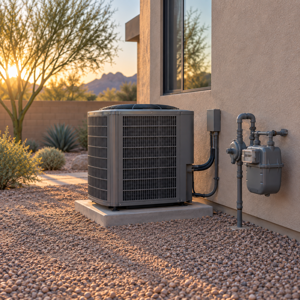
Every replacement quote in the Valley arrives at the same fork. The cooling side of the system is settled by the load calculation and the budget. The heating side asks the homeowner to choose among a heat pump, a gas furnace, and a system that uses both, and most people make that choice quickly, on the strength of whatever the last house had.
The money around that choice has changed. Much of what a homeowner will read online about heat pump incentives describes 2025: a $2,000 federal tax credit and an APS rebate. Neither applies to a system installed today, and no Valley utility now pays more for one kind of heat than for the other. The decision has to be made on the house, the utility bills, and comfort.
This article explains what the Valley’s utilities and the federal government offer today, how much heating a Valley home needs, how each type of system makes heat, and how the decision sorts out by the kind of house you own. It applies across our service area: Scottsdale, Paradise Valley, Fountain Hills, Phoenix, Tempe, Mesa, Chandler, and Queen Creek.
Varsity Zone installs heat pumps, gas furnaces, and dual-fuel systems, and we do not favor one over the others. A heat pump is the right answer in some Valley homes and a gas furnace is the right answer in others; the purpose here is to help you tell which house you live in.
What the Utilities and the Federal Government Offer in 2026
Incentives are usually the first question, so they come first here.
For SRP customers, the Cool Cash rebate is fuel-neutral. SRP pays $75 per ton for single-stage equipment, $150 per ton for multi-stage equipment, and $225 per ton for variable-capacity equipment, all at 15.2 SEER2 or higher and up to $1,125 per system, and it pays the same amount whether the new outdoor unit is an air conditioner or a heat pump. On a split system, both the outdoor unit and the indoor coil or air handler must be replaced. The current program requires installation before April 30, 2027 and an application within six months of installation. SRP’s rebate therefore does not tilt the heating decision in either direction.
APS customers have no equipment rebate to weigh; the utility’s residential rebates ended on January 1, 2026. APS does have a rate request pending before the Arizona Corporation Commission that would raise the average residential bill by roughly 16 percent, or about $20 per month. Hearings concluded in July, the administrative law judge’s recommendation is expected by late November, the Commission’s deadline to vote is December 31, and any new rates would take effect in early 2027. An APS customer comparing operating costs should run the comparison twice: once at today’s price and once with the requested increase applied.
The federal picture is settled. The Energy Efficient Home Improvement Credit under Section 25C does not apply to equipment installed after December 31, 2025. Older web pages, including some on government sites, still describe the credit; do not build a budget around it.
The gas utilities offer nothing that bears on the furnace decision. The 2026 Arizona residential rebate application from Southwest Gas lists low-flow showerheads, clothes washers, and windows; it does not list a furnace. The City of Mesa runs its own gas utility, serving 95 square miles of Mesa and a 235-square-mile area that reaches into Queen Creek, San Tan Valley, and Pinal County, and its appliance rebate covers gas water heaters and pool heaters, not furnaces.
How Much Heat a Valley Home Needs
The National Weather Service’s 1991 to 2020 normals for Phoenix Sky Harbor put the average January high at 67.6 degrees and the average January low at 46.0 degrees. July’s normal high is 106.5. The cooling season is long and severe, the heating season is short and mild, and equipment here is sized for cooling first.
Sky Harbor sits at the warm end of the record. The same NWS normals put Scottsdale’s station at an annual average of 73.3 degrees and Deer Valley’s at 72.6, against 75.6 at the airport. A home on the edge of the metro area, whether in Fountain Hills, north Scottsdale, or Queen Creek, should be evaluated against its own overnight lows and not against the airport’s.
Heating still matters on a 46-degree morning in a house with tile floors. The system simply works far fewer hours in heating than in cooling, so a difference in heating efficiency is worth fewer dollars here than it would be in a cold climate. That fact runs through every recommendation below.
How Each System Makes Heat
Gas Furnace
A gas furnace burns natural gas in a sealed heat exchanger while a blower pushes house air across it. Its efficiency rating is AFUE, annual fuel utilization efficiency. Goodman describes it plainly: an 80 percent AFUE rating means 80 cents of every energy dollar warms the home. The standard-efficiency furnace is an 80 percent model. Furnaces rated 90 percent and above are condensing furnaces, which recover heat from the exhaust; the Department of Energy notes that condensing models with sealed combustion draw their combustion air directly from outdoors.
Gas heat has a recognizable feel. Trane describes furnace air as hot and dry, and heat pump air as warm, delivered at a lower temperature with gentler airflow. Homeowners who grew up with gas heat often prefer it, and the preference is legitimate; comfort is part of the decision.
Heat Pump
A heat pump is an air conditioner that can run in reverse. In summer it moves heat out of the house; in winter it moves heat in. ENERGY STAR explains the efficiency advantage: a heat pump moves heat and does not convert it from fuel, so it can deliver up to three times more heat energy than the electrical energy it consumes. The Department of Energy’s purchasing guidance states that heat pumps work well in hot and dry climates, and it groups Arizona with the hot-dry states. Heating efficiency is rated in HSPF2; the higher the number, the less electricity the unit uses to deliver the same heat.
Nothing burns inside a heat pump, so there is no flue, no gas valve, and no combustion byproduct; ENERGY STAR lists the absence of direct emissions such as carbon monoxide among the benefits. A properly maintained gas furnace is safe, and it carries an annual inspection obligation, covering the heat exchanger, the venting, and the burners, that a heat pump does not.
Backup Heat
Most heat pump air handlers include electric resistance heat strips. The Department of Energy’s guidance explains why: residential heat pumps are usually selected on cooling capacity, resistance elements are added to cover any heating shortfall, and those elements are inefficient enough that their use should be kept to a minimum. In the Valley, equipment sized for summer has heating capacity to spare on a typical winter morning; Trane states that its current variable-speed heat pumps deliver full heating capacity down to about 27 degrees, nearly twenty degrees colder than a normal January low at Sky Harbor. The strips should run rarely. Two things keep it that way: a thermostat designed for heat pumps, which raises the temperature gradually, and a contractor who sizes the strips to the calculated heating load.
Dual Fuel
A dual-fuel system pairs a heat pump outdoors with a gas furnace indoors. The heat pump handles cooling and most of the heating; the furnace takes over below an outdoor temperature chosen at installation. Lennox describes its version as switching automatically between electricity and gas according to which is more cost-efficient for the weather. ENERGY STAR’s buying guidance makes the practical case: when a home has a relatively new furnace and an aging air conditioner, replacing the air conditioner with a heat pump creates a dual-fuel system for a modest extra cost over a straight air conditioner.
Trane describes the usual arrangement in colder states: the heat pump heats until the outdoor temperature nears freezing, and the furnace takes over below that. With a normal January low of 46 degrees at Sky Harbor, a Valley system set that way would heat with the heat pump on a normal winter morning and hold the furnace for the coldest nights. The switchover is a setting, not a fixed property of the equipment, and it should be chosen from your gas and electric prices, as described later in this article.
The Decision by House Type
The right answer depends less on the equipment catalog than on what is already in the house. Four situations cover nearly every home we see.
A Gas Furnace With a Split Air Conditioner
A home with a gas meter, a furnace indoors, and an air conditioner outdoors has three realistic choices.
- Replace like for like: a new air conditioner and a new gas furnace. The gas line, the flue, and the electrical circuit are already in place, which makes this the simplest installation. SRP’s Cool Cash applies to the cooling side at the same per-ton rates a heat pump would earn.
- Go dual fuel: keep a gas furnace indoors and replace the air conditioner with a heat pump. A sound furnace can stay; a furnace at the end of its life can be replaced.
- Convert to all-electric: a heat pump with an air handler, with the gas furnace removed. This remains a legitimate choice on its merits, and it is the only one of the three that can eliminate a gas bill when the furnace is the home’s last gas appliance. An air handler with resistance backup needs a 240-volt circuit that the furnace never required; Trane notes that its 120-volt modular air handler is designed to take a furnace’s place without major electrical upgrades.
Our general guidance for this home: when the furnace is relatively new and in good condition, dual fuel is the most flexible answer and the least disruptive. When both pieces are at the end of their lives and other gas appliances will remain, like for like avoids the electrical and venting work that a conversion requires. When the furnace is the last gas appliance in the house, price the all-electric conversion and weigh it against the year-round cost of keeping a gas account open.
An All-Electric Home With Resistance Heat
Some Valley homes cool with a straight air conditioner and heat with nothing but electric resistance strips or an electric furnace. This is the easiest decision in the article. A heat pump replaces the air conditioner, uses the same ducts, and delivers the same heat for a fraction of the electricity. ENERGY STAR lists lower energy bills from replacing electric resistance heat among the benefits of a heat pump, and for SRP customers the Cool Cash rebate applies to the new system as it would to any qualifying replacement.
A Rooftop Package Unit
Older single-story homes in south Scottsdale, Tempe, Mesa, and central Phoenix often carry a single package unit on the roof. Package units come in two configurations, packaged heat pump and packaged gas/electric, and a home with a gas meter may have either one. Replacing a package unit with the same configuration is typically a one-day crane job. Changing configuration is a larger project: moving from gas/electric to a heat pump means capping the rooftop gas line and confirming that the electrical circuit can carry resistance backup, and moving the other way means running gas to the roof. For most package-unit homes the practical answer is to keep the configuration the house was built around and to spend the decision on efficiency tier and duct condition.
An Existing Heat Pump
A home that already heats with a heat pump has the simplest path. The ducts, the electrical service, and the thermostat wiring already suit the equipment, and SRP’s Cool Cash tiers apply as usual. The remaining question is efficiency tier, which the equipment section below addresses.
Larger homes in Paradise Valley and north Scottsdale frequently run two or three systems, and the answer does not have to be the same for each. A dual-fuel system serving the main living area, with heat pumps on the bedroom wings, is one workable arrangement. A two-story home in Chandler or Queen Creek with the furnace in the attic presents a different conversion job than a single-story Tempe ranch with a package unit on the roof; the quote should reflect the house.
Running the Operating Cost Comparison on Your Own Bills
No article can tell you which fuel is cheaper in your house, because the answer depends on your electric plan, your gas rate, and your equipment. Trane gives its own customers the same advice: run the comparison with recent utility bills in hand. The arithmetic is simple enough to do yourself.
Start with the units. A therm of natural gas contains 100,000 Btu, and an 80 percent furnace delivers 80,000 of them to the ducts. HSPF2 expresses the heat a heat pump delivers, in Btu, per watt-hour of electricity over a standardized heating season; multiply it by 1,000 to get Btu per kilowatt-hour. A heat pump at the ENERGY STAR minimum of 7.8 HSPF2 delivers about 7,800 Btu per kilowatt-hour, so it needs roughly ten kilowatt-hours to match one therm burned in an 80 percent furnace. A 9.5 HSPF2 inverter system needs about eight and a half.
Then price both sides. On the gas bill, divide the usage-based charges by the therms used to find your cost per therm. On the electric bill, find the winter price per kilowatt-hour for your plan; on a time-of-use plan, use the off-peak price if your heat runs mostly overnight and early in the morning. Multiply the electric price by ten. If the result is lower than your cost per therm, the heat pump is the cheaper heat; if it is higher, the furnace is. As a reference point only, SRP’s rebate page uses 11 cents per kilowatt-hour in its savings estimates, and at that price ten kilowatt-hours cost $1.10.
One other item finishes the comparison. A gas account carries a monthly service charge in every month of the year, including the months when the furnace never runs. If the furnace is the home’s only gas appliance, converting to a heat pump ends that charge; if the water heater, range, dryer, or pool heater burn gas, it does not.
Apply that arithmetic to furnace efficiency as well. The Department of Energy’s purchasing guidance for the Southern region, which includes Arizona, calculates that a 90 percent furnace saves $549 in energy cost over a 21-year life compared with an 80 percent furnace of the same capacity, and that it pays for itself only if it costs no more than that amount extra. Trane’s furnace product manager is quoted on the company’s own site saying that a high-efficiency furnace makes sense in regions with colder climates and higher utility costs. SRP’s own estimates show where the larger dollars are: replacing an old 11 SEER system with a four-ton single-stage unit at the rebate minimum saves about $320 per year in cooling, and a variable-capacity system saves about $490; the Department of Energy’s furnace figure works out to about $26 per year. In the Valley an 80 percent furnace is usually the rational purchase, and the money is better spent on the cooling side of the system.
Equipment We Install
Varsity Zone installs Trane, Bosch, Lennox, Daikin, Goodman, and AC Pro. Across those lines we can build a heat pump system, a gas furnace with an air conditioner, or a dual-fuel system, so the brand decision and the fuel decision are separate.
- Bosch IDS Premium Connected: a fully modulating inverter heat pump rated up to 20 SEER2 and 9.5 HSPF2. As variable-capacity equipment it falls in SRP’s $225-per-ton tier.
- Trane: gas furnaces from 80 percent AFUE to a modulating model rated up to 97.3 percent, along with heat pumps that pair with them in dual-fuel systems.
- Lennox furnaces: a line that runs from 80 percent models to a variable-capacity furnace rated up to 99 percent AFUE, with dual-fuel operation when paired with a compatible Lennox heat pump.
- Daikin whole-home heat pumps: inverter systems; Daikin states that R-32 refrigerant will be used in all of its home heat pumps in North America.
- Goodman gas furnaces: 80 percent and 90-plus percent lines, and the value tier for a like-for-like furnace replacement.
- AC Pro: heat pumps, furnaces, air handlers, and both gas/electric and heat pump package units, which covers every configuration discussed in this article.
Whatever the brand, the matched indoor and outdoor combination must appear in the AHRI directory at 15.2 SEER2 or higher to qualify for Cool Cash.
Installation Details That Decide Whether the Choice Works
- Load calculation. SRP requires a Manual J load calculation with the rebate application for single-stage equipment, and ENERGY STAR advises homeowners to have the contractor verify system size with Manual J on any replacement. The same calculation reports the heating load, which sizes the backup heat strips and informs the dual-fuel switchover temperature.
- Ducts. The Department of Energy’s guidance on furnaces and on heat pumps names oversizing and leaky ducts among the installation problems that erase efficiency gains. Either system loses its advantage when the ducts leak into the attic; have them evaluated as part of the quote.
- Permits. A like-for-like replacement and a fuel conversion are different jobs to a building department. Phoenix exempts in-kind replacements of outdoor units of five tons or less at one- and two-family homes from a mechanical permit; a project that changes the fuel, the venting, or the electrical service is not an in-kind replacement. Mesa’s gas utility advises customers to contact the city or county permit office before adding a gas appliance, and notes that added gas load can require a larger meter. Your contractor should confirm the requirement with your municipality before work begins.
- Carbon monoxide alarms. Any home that burns gas needs working carbon monoxide alarms. That is true with an old furnace, a new furnace, or a dual-fuel system.
What the Quote Should Tell You
A replacement quote should let you compare configurations on paper. Whichever direction you lean, ask for the following in writing.
- For any system: the Manual J load calculation, the AHRI reference number for the matched equipment, the SEER2 rating, the Cool Cash tier if you are an SRP customer, and the condition of the ducts.
- For a heat pump: the HSPF2 rating, the size of the backup heat strips in kilowatts, the electrical circuit the air handler requires, and the thermostat model.
- For a gas furnace: the AFUE rating, the venting method, the blower motor type, and whether the furnace can be paired with a heat pump later.
- For dual fuel: the switchover temperature the installer proposes and the gas and electric prices used to choose it.
A quote that names only a brand, a tonnage, and a price does not contain enough information to choose among configurations.
Where the Fall Replacement Credit Fits
Fall is the season in which this decision is easiest to make well, because nothing is broken and the schedule is yours. Through October 31, 2026, Varsity Zone is offering a $1,000 credit toward a qualifying new HVAC system, with two maintenance visits included; qualifying systems must be installed by October 31, 2026, and terms apply. Ask which configurations qualify when you request the quote.
To talk through the decision for your house, call our office at 480-590-4647 or book online from our home page. Financing is available, and our Season Ticket Maintenance Plan keeps either kind of system inspected on schedule.
Frequently Asked Questions About Heat Pumps and Gas Furnaces in Arizona
Q: Should I set the thermostat back at night with a heat pump?
ENERGY STAR advises against it. A furnace saves fuel when the thermostat is turned down overnight; a heat pump does not, and a large morning recovery can call on the resistance backup. ENERGY STAR’s guidance is to pick a comfortable temperature and leave it, and to set the system to heat or to cool, not to auto, so that it does not switch modes on a mild day. The Department of Energy adds that thermostats designed for heat pumps raise the temperature gradually to keep the resistance elements off.
Q: Does gas heat dry out the air more than a heat pump does?
Trane says it does. Its guidance describes furnace heat as drier and notes that a heat pump does not remove humidity from the air while heating. Desert air is dry to begin with, so a homeowner who is bothered by static and dry skin in January may find heat pump heat more comfortable, and a homeowner who likes the quick, hot recovery of a furnace may not care. It is a comfort preference, and it belongs in the decision.
Q: Does a heat pump need more maintenance than a furnace and an air conditioner?
A heat pump works in both seasons, so its outdoor unit runs year-round. The Department of Energy’s guidance states that regular maintenance, including filter replacement, is necessary to maintain peak performance, and ENERGY STAR adds that heat pumps work best with clean filters. A gas furnace adds its own combustion checks. We recommend two visits a year for either system, one before cooling season and one before heating season.
Q: What is a dual-fuel switchover temperature, and who sets it?
It is a thermostat setting, chosen at installation, below which the system heats with gas and above which it heats with the heat pump. It should be set from your gas and electric prices using the comparison described above, not left at a factory default, and it can be changed later if prices change.
Hello, I am Andy Pasterchick, owner of Varsity Zone HVAC of Scottsdale. I proudly serve our community with honest, high-quality HVAC services throughout Scottsdale, Phoenix, Paradise Valley, and the surrounding areas. This guide helps Arizona homeowners choose among a heat pump, a gas furnace, and a dual-fuel system for a Valley home.