
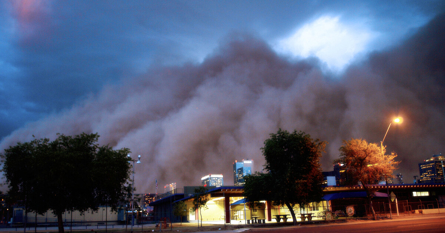
The National Weather Service closes the Arizona monsoon on September 30. Between June 15 and that date, the Valley absorbed a full season of outflow winds, dust walls, and the fine soil they carry, and much of that material now rests where homeowners never look: on the return side of the air handler, on the evaporator coil, and inside attic ductwork that has been drawing on dusty air since June. The timing matters for a second reason: Arizona’s Valley fever counts rise into the fall and early winter, and the fungus that causes the disease travels on exactly the dust the monsoon stirred up.
This article separates what a residential air filter does from what it does not do. The short version is blunt: no furnace filter, media cabinet, or electronic air cleaner prevents Valley fever, because the exposure that infects people happens outdoors, in open air that never passes through a duct. Filtration still has a role: it lowers the amount of dust circulating inside the house, it protects the equipment that dust would otherwise foul, and the federal agency that studies the disease lists indoor air filtration among the steps that help reduce exposure. Understanding where each measure sits in that hierarchy is the purpose of the sections that follow.
What Valley Fever Is, and Where the Dust Comes From
Valley fever is the common name for coccidioidomycosis, a lung infection caused by breathing in spores of a soil fungus called Coccidioides. The Centers for Disease Control and Prevention (CDC) describes the fungus as living in the soil and dust of certain regions, with the desert Southwest at the center of its range. According to the CDC, people become infected by inhaling the spores; the disease does not spread from person to person or between people and animals. Some people breathe in the spores and never become ill. Others develop a respiratory illness that a February 2026 report in the CDC’s Morbidity and Mortality Weekly Report characterizes as typically self-limited and pneumonia-like. The CDC states that approximately 5 to 10 percent of people who get Valley fever develop serious or long-term problems in their lungs, and that in about 1 percent the infection spreads from the lungs to other parts of the body. Anyone with a lingering cough, fatigue, fever, or shortness of breath after a dusty stretch should raise Valley fever with a physician; this article addresses buildings and equipment, not diagnosis.
The numbers in Arizona are not small. The Arizona Department of Health Services (ADHS) reports that 14,763 Arizonans tested positive for Valley fever in 2024, of whom 986 were hospitalized and 86 died. The MMWR report notes that Arizona and California together account for more than 95 percent of the cases reported in the United States, that annual incidence in Arizona roughly doubled between 2005 and 2022, and that more than 95 percent of Arizona’s cases come from the Sonoran Desert region that includes Maricopa, Pima, and Pinal counties, where the disease is described as hyperendemic. The University of Arizona’s Valley Fever Center for Excellence maintains public and clinical resources for residents who want a deeper reference.
How the dust becomes airborne: In the soil, the fungus grows as a mold. The CDC’s life-cycle summary explains that the mold’s filaments fragment into spores called arthroconidia, which measure only 2 to 4 microns in diameter and are easily aerosolized when the soil is disturbed. Wind, construction, grading, off-road driving, digging, and yard work all lift them. For scale, the Maricopa County Air Quality Department describes PM10, the coarse particulate it calls dust, as particles 10 microns or smaller, and notes that a single human hair measures 70 to 100 microns. A Valley fever spore is therefore well inside the size range that triggers the county’s dust High Pollution Advisories, and small enough to stay suspended long after the visible wall of a haboob has passed.
Why late September is the moment: The MMWR report states that Valley fever incidence in Arizona typically peaks during October through January, overlapping the state’s second annual rainy season. ADHS has described the same pattern in plainer terms: cases typically peak in late fall and early winter, with a minor peak from June to August. The monsoon, then, is not the peak; it is the setup. The Valley Fever Center for Excellence explains that the fungus grows toward the surface during rainy periods and breaks into spores once the ground dries, and the case counts arrive weeks later, after the lag between exposure, illness, testing, and reporting. A homeowner reading this as the monsoon closes is standing at the front edge of the season, not the back.
The Honest Answer: No Residential Filter Prevents Valley Fever
The CDC’s guidance on reducing risk lists the following measures: avoid areas with a lot of dust, such as construction or excavation sites, and wear a fitted N95 respirator if that is not possible; stay inside during dust storms and close the windows; avoid activities that involve contact with soil, such as gardening; use air filtration measures indoors; and clean skin injuries well with soap and water. Filtration appears on that list, and it appears after the behavioral measures for a reason. A central air filter treats only the air that passes through the return duct, and only while the blower is running. It does nothing about the air a homeowner breathes while pulling weeds, walking a dog through an outflow wind, or driving with the windows down past a grading site on the Loop 101. It does nothing about the dust that enters through an open window during a storm, because that dust settles on floors, furniture, and lungs before the return grille ever sees it.
What filtration does accomplish is narrower and still worthwhile. It reduces the concentration of dust suspended in the indoor air over time, which is the reason the CDC includes it. It protects the evaporator coil, the blower wheel, and the ductwork from the coating of fine soil that a dust-storm summer deposits, and that protection has consequences for efficiency and equipment life that are far easier to demonstrate than any health outcome. Nobody should buy a filter upgrade expecting it to make a house safe from Valley fever. Homeowners should buy one expecting cleaner indoor air, a cleaner coil, and a system that is easier to keep running through the next summer.
MERV 8 Versus 11 Versus 13: What the Numbers Mean for a 2 to 4 Micron Particle
MERV stands for Minimum Efficiency Reporting Value. The U.S. Environmental Protection Agency (EPA) explains that the rating reports a filter’s ability to capture particles between 0.3 and 10 microns, and that it comes from a test method developed by the American Society of Heating, Refrigerating and Air-Conditioning Engineers (ASHRAE), published as ASHRAE Standard 52.2. The test measures capture in three size bands: 0.3 to 1.0 microns, 1.0 to 3.0 microns, and 3.0 to 10.0 microns. A Valley fever spore, at 2 to 4 microns, straddles the middle band and the bottom of the coarse band, so those two columns are the ones that matter here.
The EPA publishes the minimum capture efficiency for each rating. The relevant rows are as follows:
- MERV 8: at least 20 percent of particles from 1.0 to 3.0 microns and at least 70 percent of particles from 3.0 to 10.0 microns; no capture is required in the finest band.
- MERV 11: at least 65 percent from 1.0 to 3.0 microns, at least 85 percent from 3.0 to 10.0 microns, and at least 20 percent from 0.3 to 1.0 microns.
- MERV 13: at least 85 percent from 1.0 to 3.0 microns, at least 90 percent from 3.0 to 10.0 microns, and at least 50 percent from 0.3 to 1.0 microns.
- MERV 16: at least 95 percent in all three bands.
- HEPA: 99.97 percent at 0.3 microns, a standard that sits outside the MERV scale and that the EPA associates with portable air cleaners rather than duct-mounted furnace filters.
The MERV 8 line rewards a second reading. The one-inch pleated filter that ships with many Valley systems, and that most homeowners buy at the hardware store, is required to stop only one in five of the particles in the size band where a Valley fever spore lives. Stepping to MERV 11 raises that floor to roughly two in three; stepping to MERV 13 raises it to better than five in six. The EPA’s recommendation for anyone upgrading is to choose a filter rated at least MERV 13, or as high a rating as the system fan and filter slot can accommodate, and to consult an HVAC technician to determine what the system will tolerate.
Three qualifications keep those percentages honest. First, they are minimums measured on a single pass through new media under laboratory airflow; a filter in a Scottsdale attic after a summer of haboobs is neither new nor operating under laboratory conditions. Second, they describe only the air that goes through the filter. Air that goes around the filter through a gap in the filter rack, a warped filter door, or a leaking return duct is not filtered at all, and the EPA specifically warns homeowners to confirm that no filters are missing and that air cannot bypass the filter through gaps around the holder. Third, the filter works only while air moves through it. A system that cycles briefly in October turns over the house air far less often than one running most of the day in July, so the same filter delivers less cleaning in the very months when the outdoor spore load is climbing.
Airflow is the trade-off: Higher MERV ratings are achieved with denser media, and denser media resists airflow. A one-inch MERV 13 filter forced into a return designed for a fiberglass pad can raise static pressure enough to cut airflow across the coil, reduce cooling capacity, and shorten the life of a blower motor. The engineering answer is surface area: a four- or five-inch media cabinet spreads the same rating across deep pleats with many times the media area of a one-inch filter, which is why the manufacturers of these cabinets describe them as delivering higher filtration with little airflow restriction and less stress on the blower. A technician should measure total external static pressure before and after any filtration upgrade; that number, not the package label, decides whether a given system can carry MERV 13 or better.
Where the Dust Actually Gets In: Attic Ducts, Return Leaks, and Filter Bypass
A filter upgrade addresses the air that arrives at the filter. In a great many Valley homes the more consequential dust path bypasses the filter entirely, and it runs through the attic.
Most single-family homes across the Valley place the air handler and the entire duct system in an unconditioned attic, and most of that ductwork is flexible duct. ENERGY STAR reports that in a typical house about 20 to 30 percent of the air moving through the duct system is lost through leaks, holes, and poorly connected ducts, and it lists ducts located in an attic, rooms that are difficult to cool, and tangled or kinked flexible ducts among the signs of a poorly performing system. Those signs describe a large share of the housing stock in this service area.
Return leaks pull dust in: The return side of the duct system operates under suction. Any opening on that side, whether a separated collar, a torn flex liner, a boot that was never sealed to the drywall, or a return plenum with gaps at the platform, draws air from the surrounding space into the system. In an attic, that surrounding air carries whatever the summer’s dust storms deposited in the insulation. Where the filter sits at the return grille in the ceiling, as it does in many Valley homes, air that enters through a leak downstream of that grille has already passed the only filter in the system. It goes straight to the coil, the blower, and the supply registers, and it does so every hour the system runs.
Supply leaks depressurize the house: Leaks on the supply side lose conditioned air into the attic, which is expensive, and they do something less obvious. When the supply side loses more air than the return side takes in, the house runs at a slight negative pressure and makes up the difference by drawing outdoor and attic air in through every crack, recessed light, and plumbing penetration. During a dust advisory, that makeup air is the same air the county is warning residents to stay out of.
The fix is unglamorous: ENERGY STAR advises sealing duct leaks with mastic sealant or metal tape, insulating any ducts that can be reached in attics, and sealing the connections at vents and registers where they meet the ceiling and walls, which it identifies as common locations for leaks and disconnected ductwork. It also states plainly that cloth duct tape should never be used, because it does not last. A contractor can quantify the problem with a duct leakage test that pressurizes the duct system and measures how much air escapes, which turns a guess into a number before and after sealing. The EPA’s duct guidance adds that ducts in attics should be properly sealed and insulated for a further reason: uninsulated ducts in hot spaces invite condensation, and condensation inside ductwork is the precondition for biological growth.
Dusty registers versus dirty ducts: A clarification that saves homeowners money concerns the return grille. The EPA notes that it is normal for return registers to get dusty as dust-laden air is pulled through the grille, and that a dusty grille does not indicate that the ducts themselves are contaminated with heavy deposits. The grille can be vacuumed or removed and washed. Dust visibly blowing out of the supply registers is a different matter, and it is addressed in the next section.
Duct Cleaning: When It Is Warranted and When It Is a Sales Pitch
Every October the coupons arrive, and every October the pitch is the same: a summer of dust storms has filled the ducts, and a cleaning will restore the air quality and efficiency of the home. The EPA has published detailed guidance on residential duct cleaning, and its conclusions bear quoting closely because they contradict most of the marketing.
The agency states that duct cleaning has never been shown to prevent health problems, that studies do not conclusively demonstrate that particle levels in homes increase because of dirty ducts, and that much of the dirt in ducts adheres to duct surfaces and does not necessarily enter the living space. It does not recommend that ducts be cleaned routinely, only as needed. It advises homeowners not to hire duct cleaners who make sweeping claims about health benefits, because such claims are unsubstantiated, and not to hire cleaners who recommend duct cleaning as a routine part of system maintenance.
The EPA identifies three conditions under which cleaning is warranted:
- Substantial visible mold growth inside hard-surface ducts or on other components of the system. The agency advises asking the provider to show the mold, notes that a positive identification may require laboratory analysis, and states that wet or moldy insulated duct cannot be effectively cleaned and should be removed and replaced.
- Ducts infested with vermin, such as rodents or insects.
- Ducts clogged with excessive amounts of dust and debris, or particles actually being released into the home from the supply registers.
If any of those conditions exists, the EPA adds, it usually points to an underlying cause, and the cause must be corrected before cleaning, retrofitting, or replacing the ducts or the problem will recur. In this service area the underlying cause is very often the leakage described in the previous section. Cleaning a flex duct system that still has open collars in the attic buys a few months.
Two related practices call for caution. Some providers propose spraying chemical biocides or introducing ozone into the ductwork to kill mold and bacteria; the EPA reports that little research demonstrates their effectiveness inside ducts, that no biocides are registered for use on fiberglass duct board or fiberglass-lined ducts, and that ozone is a lung irritant regulated in outdoor air. Others propose sealants sprayed inside the ducts to encapsulate dust; the EPA, along with the industry associations it cites, does not recommend routine use of such sealants, and it notes that steam cleaning or any wet method should not be used on any type of duct. The EPA also observes that flexible duct can be cleaned with soft brushes but that it is often more economical simply to replace accessible flex duct, which is the honest recommendation for a good deal of the aging flex in Valley attics.
What does help the equipment is cleaning the components rather than the ducts. The EPA notes that some research suggests cleaning cooling coils, fans, and heat exchangers may improve efficiency and extend operating life, while little evidence exists that cleaning only the ducts improves efficiency. After a summer of dust storms, the productive first step is an inspection: pull the filter, look at both sides of the coil with a flashlight, check the blower wheel, and look inside the return plenum. A coil that light will not pass through and a blower wheel with caked vanes are real problems with real efficiency costs, and they are corrected with a coil and blower cleaning, not a duct-cleaning coupon.
Filter Cadence After a Dust-Storm Summer
The standard advice is a starting point, not a schedule. ENERGY STAR’s maintenance checklist calls for inspecting, cleaning, or changing air filters once a month in a central air conditioner, furnace, or heat pump, and warns that a dirty filter increases energy costs and can damage equipment, leading to early failure. Filter packaging often promises three months of service. A one-inch filter that ran through a Valley July and August behind a return grille is frequently loaded well before the printed interval, and the interval on the box was never written with a haboob in mind.
A workable rule for the Valley is as follows:
- Inspect the filter monthly from now through the end of the year, and replace it whenever the media is visibly loaded, regardless of the date it was installed.
- After any dust storm or county High Pollution Advisory for PM10, inspect the filter within a few days.
- For four- and five-inch media cabinets, treat the manufacturer’s interval as a maximum, not a target. Daikin’s guidance for its premium air cleaner is once or twice a year based on conditions in the home; Trane advises vacuuming or rinsing the CleanEffects collection cells every three to nine months depending on usage. Arizona conditions run to the short end of every one of those ranges.
- Keep a spare filter of the correct size on hand, so that a loaded filter is replaced rather than run.
Filtration is one part of a broader dust-control routine, and the rest of it costs little:
- Close windows and doors during dust storms and dust advisories, which is the CDC’s advice for Valley fever and every Valley city’s advice for monsoon safety.
- Sign up for the Maricopa County Air Quality Department’s email or text alerts, which notify residents when a High Pollution Advisory is issued or when dust levels rise at monitoring sites, and check the county’s live air quality map before outdoor work. Vacuum with a HEPA or high-efficiency bag vacuum, as the EPA recommends, because ordinary vacuuming can raise the amount of dust in the air and in the ducts.
- During any renovation or construction that produces dust, seal off the supply and return registers and leave the system off until the dust is cleaned up, per the EPA.
- Schedule a fall pre-season check-up, which ENERGY STAR recommends before each heating season, and ask the technician to clean the coil and drain pan while the panels are off, which the EPA suggests as part of any service visit.
- For bedrooms or a home office, a portable HEPA air cleaner supplements central filtration; the EPA’s Guide to Air Cleaners in the Home explains how to size one by clean air delivery rate.
Equipment Options for Valley Homes
Varsity Zone HVAC of Scottsdale installs and services whole-home filtration from the brands it carries, and the options fall into two categories. The performance figures below are each manufacturer’s own published claims under that manufacturer’s test conditions.
Media air cleaners: These are deep-pleated cabinets installed at the air handler that replace the one-inch filter with four or more inches of media.
- Clean Comfort media air cleaners, sold with Goodman equipment, are offered as the AM11 CleanFit series rated MERV 11 and the AM13 series rated MERV 13, with cabinets sized to match the furnace or air handler and replacement media available in MERV 11 and MERV 13 with carbon.
- The Lennox Healthy Climate Carbon Clean 16 is a MERV 16 media air cleaner that Lennox states captures more than 95 percent of particles down to 0.3 microns, with activated carbon in the media for odor reduction, and that Lennox describes as delivering that filtration without restricting airflow on the basis of its in-duct testing.
- The Daikin ONE Premium Air Cleaner is a MERV 15 media cabinet with a five-and-one-quarter-inch pleated filter that Daikin states removes more than 85 percent of particles down to 0.3 microns at rated airflow, with a catalyst insert intended to reduce formaldehyde and ozone in the airstream.
Electronic air cleaners: The Trane CleanEffects Whole Home Air Cleaner uses an electrically charged field and collection cells rather than disposable media. Trane states that it removes up to 99.98 percent of particles as small as 0.3 microns from the filtered air, that it carries a clean air delivery rate of 1,200, that the collection cells are cleaned rather than replaced, and that it contributes less than 0.3 parts per billion of ozone to the living space, well below the 50 parts per billion voluntary limit Trane cites for medical devices.
Replacement media for these cabinets, along with standard pleated filters in the common Valley sizes, is stocked through AC Pro, the HVAC distributor whose equipment line Varsity Zone also carries.
None of these products is a drop-in decision, because a MERV 16 cabinet on a system with undersized returns or a single-speed blower can create the same airflow problem as a one-inch MERV 13 filter; the static pressure measurement described earlier is the gate every one of these upgrades passes through first.
What the Valley’s Cities Tell Residents About Dust Storms
Every municipality in this service area publishes monsoon and dust-storm guidance, and the advice for people is the same advice that protects a house: get inside, close the openings, and wait. The National Weather Service office in Phoenix maintains a monsoon safety page covering dust storms, downbursts, and flash flooding for the entire metropolitan area.
- The City of Phoenix’s monsoon resources page defines the season as June 15 to September 30 and notes that storms peak between mid-July and mid-August.
- The City of Scottsdale’s emergency preparedness page covers monsoon flooding and lists the city’s self-service sandbag locations.
- The Town of Paradise Valley’s emergency preparedness page directs residents to Maricopa County’s emergency planning tools and the county hazard mitigation plan.
- The Town of Fountain Hills is a designated StormReady community and publishes its severe-weather planning on that basis.
- The City of Tempe’s storms and monsoon page states that dust storms create zero-visibility driving conditions and advises residents to stay inside when they strike.
- The City of Mesa’s severe weather preparation page addresses monsoon storms, dust storms, and downed power lines.
- The City of Chandler’s haboob and lightning page describes how storm outflow winds pick up and drive dust ahead of the storm, forming walls of dust that rise several thousand feet above the desert floor.
- The Town of Queen Creek’s monsoon preparedness notice warns that dust storms bring wind gusts above 40 miles per hour and advises residents to move indoors and stay away from windows.
The Bottom Line for Valley Homeowners
Ranked by how much each measure changes the outcome, the list is short.
- Behavior first. Stay indoors with the windows closed during dust storms and advisories, avoid dusty sites, skip soil-contact work such as gardening on windy days, and wear a fitted N95 for dust work that cannot be avoided. This is the CDC’s guidance, and no equipment substitutes for it.
- Seal the ducts. A return leak in the attic feeds unfiltered dust into the system every hour it runs. Sealing with mastic and metal tape, verified by a leakage test, closes the largest bypass in most Valley homes.
- Raise the filtration. Move to the highest MERV rating the system can carry, which usually means a media cabinet rather than a denser one-inch filter, and confirm the choice with a static pressure measurement.
- Inspect monthly. Check the filter every month through the fall and replace it on condition, not on the calendar.
- Skip routine duct cleaning. Inspect the coil, blower, and return plenum first; clean components when they are dirty; clean ducts only when the EPA’s conditions are actually present.
Frequently Asked Questions About Valley Fever, Dust, and Your HVAC System
Hello, I am Andy Pasterchick, owner of Varsity Zone HVAC of Scottsdale. I proudly serve our community with honest, high-quality HVAC services throughout Scottsdale, Phoenix, Paradise Valley, and the surrounding areas. These questions arrive every fall once the monsoon dust settles and the Valley fever headlines begin; the answers below accompany our article, Valley Fever Season and Your HVAC: What an Air Filter Can and Cannot Do About Arizona Dust.
Q: Can an air filter prevent Valley fever?
A: No. Valley fever is caused by inhaling spores of the soil fungus Coccidioides, and the exposure that infects people happens outdoors, in air that never passes through a duct. A central air filter treats only the air moving through the return while the blower runs. The CDC’s guidance on reducing risk lists indoor air filtration among the measures that help reduce exposure, after staying inside during dust storms, closing the windows, avoiding dusty sites, and wearing a fitted N95 respirator when dust cannot be avoided. Filtration lowers the dust load inside the house and protects the equipment; it does not make a home safe from the infection.
Q: How small is a Valley fever spore, and does the size matter for my filter?
A: The CDC’s life-cycle summary measures the spores, called arthroconidia, at 2 to 4 microns. MERV ratings report capture in three size bands, and the 1.0 to 3.0 micron band is where those spores fall. A MERV 8 filter is required to capture at least 20 percent of particles in that band; MERV 11, at least 65 percent; MERV 13, at least 85 percent; MERV 16, at least 95 percent. Those figures are laboratory minimums for air that actually passes through the filter, measured on new media at test airflow.
Q: What MERV rating should I use in the Valley?
A: The EPA recommends at least MERV 13 for anyone upgrading, or as high a rating as the system fan and filter slot can accommodate, with an HVAC technician confirming what the system will tolerate. In practice that usually means a four- or five-inch media cabinet rather than a one-inch MERV 13 filter, because the deeper pleated media carries the rating across far more surface area and does not choke airflow the way a dense one-inch filter can.
Q: Will a MERV 13 filter hurt my system?
A: It can, when a dense one-inch filter goes into a return designed for a fiberglass pad. Denser media raises static pressure, which reduces airflow across the coil, cuts cooling capacity, and shortens the life of the blower motor. A technician should measure total external static pressure before and after any filtration change; that number, not the package label, decides whether a given system can carry MERV 13 or better.
Q: My return grille is covered in dust. Does that mean my ducts are dirty?
A: Not by itself. The EPA notes that return registers normally get dusty as dust-laden air is pulled through the grille, and that a dusty grille does not indicate heavy deposits inside the ducts. Vacuum the grille or remove it and wash it. Dust blowing out of the supply registers is a different signal and warrants an inspection of the coil, blower, and return plenum.
Q: How does dust get past the filter in the first place?
A: Through the ductwork. ENERGY STAR reports that a typical house loses 20 to 30 percent of the air moving through its ducts to leaks, holes, and poor connections. The return side runs under suction, so any opening in the attic draws attic air into the system; where the filter sits at the ceiling grille, as it does in many Valley homes, that air enters downstream of the filter and goes straight to the coil and blower. Gaps around the filter rack do the same thing on a smaller scale.
Q: Should I have my ducts cleaned after monsoon season?
A: Only if one of the EPA’s three conditions is present: substantial visible mold inside hard-surface ducts or on system components, a vermin infestation, or ducts clogged with excessive debris or actually releasing particles into the home. The EPA states that duct cleaning has never been shown to prevent health problems, does not recommend cleaning ducts routinely, and advises against hiring any provider who makes sweeping health claims or pitches cleaning as routine maintenance. Cleaning the coil, blower, and drain pan is the productive post-monsoon service.
Q: What about duct sealing instead?
A: Sealing addresses the actual dust path. ENERGY STAR advises mastic sealant or metal tape on duct leaks, sealed connections where boots meet the ceiling and walls, and insulation on any attic ducts that can be reached, and it states that cloth duct tape should never be used because it does not last. A duct leakage test before and after sealing turns the job into a measured result rather than an estimate.
Q: How often should I change the filter this fall?
A: Inspect it monthly and replace it whenever the media is visibly loaded, regardless of the date it went in or the interval printed on the package. ENERGY STAR’s maintenance checklist calls for monthly inspection of central system filters and warns that a dirty filter raises energy costs and can damage equipment. Inspect again within a few days of any dust storm or PM10 High Pollution Advisory; Maricopa County posts current conditions on its air quality map and offers dust alerts by email or text.
Q: Does a portable HEPA air purifier help?
A: As a supplement in a bedroom or home office, yes. HEPA media captures 99.97 percent of particles at 0.3 microns, a standard that sits outside the MERV scale, and the EPA’s Guide to Air Cleaners in the Home explains how to size a unit by clean air delivery rate. A portable unit treats one room; the central system and the ductwork determine the rest of the house.
Q: When is Valley fever season in Arizona?
A: Cases in Arizona typically peak from October through January, according to a February 2026 CDC report, with a smaller rise from June through August noted by ADHS. The monsoon sets the season up: rain lets the fungus grow near the surface, the ground dries, and wind lifts the spores. ADHS reports 14,763 cases, 986 hospitalizations, and 86 deaths in Arizona in 2024.
Q: What should I do if I think I have Valley fever?
A: See a physician. A lingering cough, fatigue, fever, or shortness of breath after a dusty stretch is reason to ask specifically for a Valley fever test, because the illness resembles other respiratory infections and is not contagious between people. These answers address buildings and equipment; diagnosis belongs to a doctor.
Varsity Zone HVAC of Scottsdale performs post-monsoon inspections, duct leakage testing and sealing, static pressure measurement, media cabinet installation, and coil and blower cleaning for homeowners in Scottsdale, Paradise Valley, Fountain Hills, Phoenix, Tempe, Mesa, Chandler, and Queen Creek. Call the office at 480-590-4647 or book online.
Arizona Dust Storm” linked to https://flickr.com/photos/32020964@N08/5917763584 and “CC BY 2.0” linked to https://creativecommons.org/licenses/by/2.0/: Photo: “Arizona Dust Storm” by Ms. Phoenix, via Flickr, licensed under CC BY 2.0; cropped.
Varsity Zone HVAC of Scottsdale performs duct leakage testing, duct sealing, static pressure measurement, media cabinet installation, and coil and blower cleaning for homeowners in Scottsdale, Paradise Valley, Fountain Hills, Phoenix, Tempe, Mesa, Chandler, and Queen Creek. To schedule a post-monsoon inspection, call the office at 480-590-4647 or book online.