
The 2026 Refrigerant Changeover: What R-454B Means for Valley Homeowners Buying a New AC
If you have shopped for a new air conditioner in Scottsdale or anywhere across the Valley this year, you have probably run into a new set of letters and numbers that were not part of the conversation two summers ago. R-454B. R-32. A2L. SEER2. EER2. The refrigerant that cooled Arizona homes for two decades is being phased out; the equipment on the truck today is built around chemistry your last system never used. None of this means your current unit is illegal, and none of it means you have to panic. It does mean the rules changed underneath a purchase most homeowners make once every fifteen years, and the sales floor is full of half-truths about what that change costs you. This guide lays out what actually happened, what is on the market now, and how the 2026 landscape affects the check you write; it is written for people buying real equipment in Phoenix heat, not for a chemistry exam.
What actually changed, and why R-410A is on the way out
The short version starts in Washington, not on your roof. In 2020, Congress passed the American Innovation and Manufacturing Act, which directed the Environmental Protection Agency to phase down the high-impact refrigerants used in cooling equipment. R-410A, the standard charge in nearly every residential system installed since the mid-2000s, carries a global warming potential of roughly 2,088. The EPA's Technology Transitions Rule set a ceiling of 700 for new residential air conditioners and heat pumps, and R-410A missed that ceiling by nearly threefold; so it had to go.
The hard line landed on January 1, 2025. After that date, manufacturers could no longer produce or import new residential systems charged with R-410A, and every major brand redesigned its lineup ahead of the cutoff. Read that carefully, because the distinction is where most of the confusion begins: this is a manufacturing ban on new equipment, not a ban on the refrigerant itself. Nothing about it reaches into the system already sitting on your roof.
Meet the replacements: R-454B and R-32
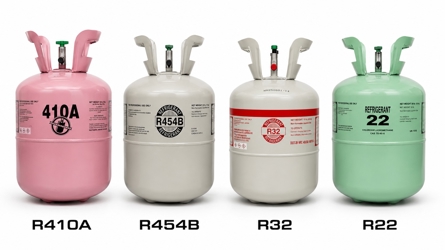
Two refrigerants inherited the market. R-454B, sold by Carrier under the Puron Advance brand name, carries a global warming potential of about 466; it is the replacement of choice for most ducted split systems, and you will find it in current equipment from Carrier, Trane, Goodman, Rheem, and Lennox. R-32, with a global warming potential near 675, went into the lineups from Daikin and LG, and it shows up most often in ductless mini-split equipment.
Both belong to a class the industry labels A2L, which denotes lower toxicity and mild flammability. The word flammability sets off alarms, and the alarm is mostly misplaced; an A2L refrigerant has a low burning velocity and needs specific conditions to ignite at all. New equipment is engineered around that classification, with sealed motor components and, where required, refrigerant leak detection built into the system. What matters for you as a buyer is simpler: the equipment installed in your home from here forward will almost certainly carry one of these two refrigerants, and that is not a menu choice; it is what the factories build now.
One point deserves nailing down, because a bad actor will eventually try to sell you around it. Neither R-454B nor R-32 is a drop-in for R-410A. The oils differ, the operating pressures differ, and the components are rated for different service lives. Charging a new A2L refrigerant into a system designed for R-410A voids the warranty and creates a genuine safety problem. If a contractor offers to convert your old unit to the new refrigerant, that is your signal to end the conversation.
Does the switch cost you more?
The honest answer in mid-2026 is: a little, and less than it did a year ago. When the A2L systems first reached the market, thin supply and new tooling pushed prices up, and early adopters paid a premium. That gap has narrowed as production matured and the new equipment became the default rather than the exception. On the equipment itself, a comparable R-454B system now prices close to what its R-410A predecessor did, and in many product lines the difference is negligible.
Where a real difference can show up is on installation day. A2L equipment carries mild-flammability handling requirements, which means some systems ship with a factory leak-detection sensor and a control board that shuts the unit down if it senses refrigerant escaping indoors. Technicians need current A2L training and recovery equipment, and on a straight changeover your contractor should evaluate whether the existing line set can be reused or must be flushed or replaced for compatibility with the new refrigerant and its oil. None of this is exotic, and none of it should double your bill; but it is real labor, and a lowball quote that ignores it is a quote that will surprise you later. Ask the contractor to spell out what the A2L transition adds to your specific job, if anything.
The install-deadline whiplash: can you still buy an R-410A system?
Here is where 2026 got messy, and where you may have heard contradictory things from two different companies in the same week. The original Technology Transitions Rule paired the manufacturing cutoff with an installation deadline: pre-2025 R-410A equipment sitting in warehouses had to be installed before January 1, 2026, or not at all. That deadline is dead. After heavy industry pushback and an estimated half-billion dollars in stranded inventory, the EPA finalized an amended rule, effective July 27, 2026, that removes the installation cutoff entirely. A contractor can now legally install pre-2025 R-410A inventory until that stock is gone, and distributors are clearing it, sometimes at a discount.
So should you buy the discounted R-410A system? Occasionally, yes; usually, no. The upfront price can be lower, the technology is proven, and every technician in the Valley knows the equipment cold. But you are buying a platform whose refrigerant is on a shrinking production quota, and the service refrigerant to recharge it will climb in price every year you own it. If the discount is deep and the unit is a like-for-like replacement you plan to run hard and retire on schedule, the math can work. If you are buying for the long haul, you are buying into a fuel that gets more expensive on purpose. Go in with your eyes open, and make the salesman show you both quotes.
"Do I have to replace my working R-410A system?" No.
Let me kill the most profitable myth in the business first. Your existing R-410A system is not illegal, and nobody is coming to pull it off your roof. The EPA does not restrict refrigerants in equipment already in the field; you can service, repair, and recharge an R-410A system for its entire useful life, which in Valley conditions runs somewhere in the twelve-to-eighteen-year range depending on how it was installed and maintained. If a company tells you a working unit "has to be replaced because of the Freon ban," you are talking to a closer, not a technician. There is no such ban.
What is true is quieter and more expensive. As production quotas on R-410A tighten, the per-pound cost of service refrigerant rises. A system that springs a leak in 2029 will cost more to recharge than the same repair would today, and a compressor failure on a fifteen-year-old unit is money you will never recover. The honest decision tree is the one every good contractor has always used, now with a refrigerant surcharge baked in: if your system is under roughly ten years old and the repair is modest, fix it; if it is past twelve years, leaking, and staring down a four-figure repair, replacing it usually beats feeding it. The refrigerant transition does not change that logic; it just raises the cost of the wrong choice.
Put numbers to it. Suppose your fourteen-year-old system loses its compressor in the middle of July. The compressor, the labor, and a fresh charge of R-410A at today's climbing prices can land in four-figure territory on a machine that already owes you nothing; and the moment the repair is done, you own a fourteen-year-old system again, on a refrigerant that costs more every year. A new variable-capacity system on the same day carries a larger sticker, but it resets the clock, lowers the summer bill, and, in SRP territory, may pull a rebate a repair never will. The refrigerant transition does not force that decision, but it does sharpen it; the older and leakier the system, the more the arithmetic favors moving on.
Why the desert changes the math: EER2, not just SEER2
Most of the country shops for an air conditioner by its SEER2 rating, the seasonal efficiency number. In the Valley, that number tells only part of the story. SEER2 averages performance across a range of conditions, including mild ones we barely have; the metric that describes how a system performs when it is 115 degrees at four in the afternoon is EER2, measured at a punishing 95-degree outdoor condition. A unit can post an impressive SEER2 and a mediocre EER2, and in Phoenix that unit will disappoint you exactly when you need it most.
The federal floor sets the baseline. Because Arizona sits in the Department of Energy's Southwest region, a new split-system air conditioner under 45,000 BTU must rate at least 14.3 SEER2 and 11.7 EER2 to be installed here at all, a standard enforced through the Air-Conditioning, Heating, and Refrigeration Institute. Heat pumps carry their own minimums. Those are floors, not targets; in this climate the EER2 number is worth paying attention to, because it governs your bill and your comfort during the stretch of the year when the system never really shuts off. When you compare quotes, do not let a contractor wave a big SEER2 sticker at you without showing you the EER2 alongside it.
This is also where sizing earns its keep, and where the refrigerant conversation connects to something older and more important. A system sized by rule of thumb, a ton per five hundred square feet or whatever the last installer used, is a system sized to fail in Fountain Hills sun or on a Phoenix heat-island lot where the pavement radiates heat well past sundown. A proper Manual J load calculation accounts for your orientation, glazing, insulation, and the specific microclimate of your address. New refrigerant, old mistake: the most efficient A2L system on the market will still run you ragged if it was sized on a hunch.
There is a comfort dimension here too, not just an efficiency one. A variable-capacity or multi-stage system does not simply cost less to run; it runs longer at lower speed, which pulls more humidity out of the air during monsoon weeks and holds a steadier temperature through the afternoon peak. A single-stage system sized a half-ton too large does the opposite: it short-cycles, blasts cold air, shuts off, and leaves the house clammy and uneven. In Valley conditions, where the machine works most of the year, that difference in behavior is something you feel every day, not just something you read on a bill once a month.
The money in 2026: what you actually qualify for now
This is the part that changed the most, and not in your favor. Two sources of money that Valley homeowners leaned on for years are gone.
Federal tax credits are the first casualty. The One Big Beautiful Bill Act, signed July 4, 2025, terminated the Section 25C energy-efficiency credit and the Section 25D credit for anything installed after December 31, 2025. If a website or a salesperson is still quoting you a federal tax credit for a 2026 air conditioner or heat pump, the information is stale; those credits no longer exist for this year's installations.
The second casualty is closer to home. Arizona Public Service ended its residential HVAC rebate program effective January 1, 2026, following an Arizona Corporation Commission decision. If you are an APS customer, the utility rebate you may have counted on for a high-efficiency upgrade is no longer on the table.
The good news, such as it is, sits with the other utility. Salt River Project Cool Cash still runs its rebate for residential electric customers, and it remains one of the better deals in the market. The rebate pays by compressor type: roughly $75 per ton for a single-stage system, $150 per ton for a multi-stage, and $225 per ton for a variable-capacity unit, capped near $1,125. The equipment has to be listed in the AHRI Verified Directory, installed by an Arizona-licensed contractor, and single-stage systems require a Manual J load calculation submitted with the application. A good contractor handles that paperwork and, with a signed assignment form, applies the rebate straight to your invoice so you are not waiting on a check. Program terms and deadlines reset each program year, so confirm the current cutoff before you sign.
To make the SRP rebate concrete: a four-ton variable-capacity system earns $225 per ton, or $900, applied straight to the invoice when the contractor files the assignment; a three-ton multi-stage unit at $150 per ton returns $450. It will not cover a system on its own, but against a five-figure changeover it is real money, and it is money an APS customer no longer has access to at all. That single difference is worth confirming before you decide which system tier to buy and, frankly, before you decide which company to trust with the paperwork.
For income-qualified households there is one more avenue worth a phone call. The state's Efficiency Arizona program administers federally funded HEAR rebates worth up to $8,000 toward a qualifying heat pump for households below 150 percent of the area median income, with a companion whole-home program expected to open later in the year. It is not for everyone, and the income limits are real, but for the households that qualify it is the largest single incentive left standing in the state.
The takeaway for 2026 is blunt: whether you save money on the incentive side now depends heavily on which utility bills you. An SRP customer in Tempe or Mesa still has a rebate to work with; an APS customer across town does not. Know which one you are before you build your budget.
The Valley buyer's playbook, neighborhood by neighborhood
The transition lands differently depending on where in the Valley you live and what kind of housing stock you own.
In Scottsdale and Fountain Hills, the story is largely retrofit. Established homes, larger square footage, and a fair amount of custom construction mean the buying decision is usually replace-in-place, and the refrigerant transition mostly shows up as a question of whether to grab discounted R-410A inventory or move to a new A2L platform on a premium variable-capacity system. In these ZIP codes the EER2 and sizing conversation matters most, because the homes are big and the sun exposure is unforgiving.
In Chandler and Queen Creek, newer construction and ongoing development mean a larger share of systems are already A2L or soon will be. Buyers here are more likely to be facing a first replacement on a home built in the last fifteen years, and the SRP rebate is often in play. Queen Creek's continued growth also means a lot of homeowners are meeting the new refrigerant on their very first system swap, before they ever learned the old rules.
In Tempe and Mesa, the housing skews older and denser, with a heavy layer of rental and investor-owned property. Here the repair-versus-replace decision is sharpest, because a large stock of aging R-410A systems is hitting the age where the rising cost of service refrigerant tips the math toward replacement. Landlords and owner-occupants alike are the ones who feel the service-refrigerant cost curve first.
And across all of it sits Phoenix proper, where the urban heat island keeps nighttime temperatures elevated and pushes systems to run longer than the same equipment would in an outlying suburb. That extra runtime is exactly why the EER2 number and honest sizing are not luxuries in this market; they are the difference between a system that keeps up in July and one that quietly gives up at the worst possible hour.
What to ask before you sign
A short, unsentimental checklist will protect you through this transition better than any brochure.
- Ask which refrigerant the quoted system uses, and whether it is new A2L equipment or discounted pre-2025 R-410A stock; then ask for both quotes so you can compare on price and on future service cost.
- Ask for the EER2 rating, not just the SEER2, and make the contractor confirm the system clears the 14.3 SEER2 and 11.7 EER2 Southwest floor.
- Ask for a Manual J load calculation in writing, and refuse any quote sized by rule of thumb.
- Ask that the equipment be matched and listed in the AHRI Verified Directory, so the outdoor and indoor units are certified as a rated pair.
- Ask whether you are an SRP or APS customer and, if SRP, whether the contractor will file the Cool Cash rebate and assign it to your invoice.
- Ask that the technicians are trained and certified for A2L service; the new refrigerants require updated handling and recovery equipment.
- Any contractor worth hiring will answer all six without flinching. A contractor who dodges the sizing question or cannot explain the refrigerant on the truck is telling you something.
The bottom line
The 2026 refrigerant changeover is real, but it is not the emergency the loudest sales pitches make it out to be. Your old system is legal and serviceable. New equipment is better, quieter, and built around chemistry the rest of the world is moving toward. The genuine risks are narrower and duller than the headlines: overpaying for a rushed replacement you did not need, buying a system sized on a guess, or missing the one utility rebate you actually qualify for. Handle those three and you come out of this transition ahead of your neighbor.
If you want a straight answer about your specific home, whether to repair or replace, which refrigerant platform fits your plans, and exactly what rebate you qualify for, Varsity Zone HVAC of Scottsdale serves Scottsdale and the surrounding Valley with load calculations done properly and quotes that show you the whole picture. Get the numbers before the next heat wave forces the decision for you.
Frequently Asked Questions About HVAC Maintenance
Q: Is R-410A banned in 2026?
Not for you. The 2020 American Innovation and Manufacturing Act ended manufacturing of new R-410A residential systems on January 1, 2025, but it did not ban the refrigerant itself. Existing R-410A systems remain fully legal to run, service, and recharge; the phase-out applies to what factories can build, not to the equipment already on your roof.
Q: Can I still buy an R-410A air conditioner?
Yes, for now. The original rule set a January 1, 2026 deadline to install leftover R-410A inventory, but an EPA final rule effective July 27, 2026 removed that cutoff. Contractors can install pre-2025 R-410A stock until supplies run out, and distributors are clearing it, sometimes at a discount. Whether that discount is worth buying into a shrinking refrigerant supply is the real question; ask for both an R-410A and an R-454B quote before you decide.
Q: What refrigerant is replacing R-410A?
Two of them. Most new ducted systems use R-454B, sold by Carrier as Puron Advance, and many ductless mini-splits from Daikin and others use R-32. Both are A2L refrigerants with a far lower global warming potential than R-410A; R-454B sits near 466 and R-32 near 675, against R-410A's 2,088.
Q: Is R-454B safe? Are A2L refrigerants dangerous?
The A2L label means mild flammability, which sounds worse than it is. These refrigerants have a low burning velocity and require specific conditions to ignite at all. New equipment is engineered for the classification, with sealed components and, where required, built-in leak detection. For a homeowner, day-to-day operation is no different from the system it replaced.
Q: Can R-454B be put into my existing R-410A system?
No. Neither R-454B nor R-32 is a drop-in for R-410A; the oils, operating pressures, and component ratings all differ. Cross-charging voids the warranty and creates a genuine safety problem. If anyone offers to convert your old unit to the new refrigerant, decline and find another contractor.
Q: Do I have to replace my working R-410A system?
No. There is no requirement to replace a functioning R-410A system, and no ban on servicing one. You can repair and recharge it for its useful life. The only real pressure is financial: as production quotas shrink, service refrigerant gets more expensive, so an old and leaky system costs more to keep alive each year.
Q: How long will R-410A be available to service my AC?
Indefinitely, in practice. The phase-down restricts new equipment, not service refrigerant, so R-410A remains legal to buy and charge into existing systems with no cutoff date. Supply will tighten and prices will climb over the coming years, but your current system will not be stranded.
Q: Does a new R-454B system cost more than an R-410A one?
A little, and less than it did a year ago. Early A2L equipment carried a premium when supply was thin; that gap has largely closed, and a comparable R-454B system now prices close to its R-410A predecessor. A2L handling can add modest labor on installation day, so ask your contractor to itemize what the transition adds to your specific job, if anything.
Q: Are there still rebates or tax credits for a new AC in 2026?
Some money is gone, some remains. The federal 25C and 25D tax credits ended for anything installed after December 31, 2025, and Arizona Public Service discontinued its residential HVAC rebates on January 1, 2026. Salt River Project Cool Cash still runs its rebate, and income-qualified households may access the state's Efficiency Arizona HEAR rebate of up to $8,000 toward a qualifying heat pump.
Q: How much is the SRP Cool Cash rebate?
It pays by compressor type: roughly $75 per ton for single-stage, $150 per ton for multi-stage, and $225 per ton for variable-capacity, capped near $1,125. The equipment must be listed in the AHRI Verified Directory and installed by an Arizona-licensed contractor, and single-stage systems require a Manual J load calculation. It applies to SRP residential customers, which covers much of Tempe, Mesa, Chandler, and Queen Creek; APS customers no longer have an equivalent.
Q: What SEER2 rating do I need in Arizona?
Because Arizona sits in the Department of Energy's Southwest region standards, a new split-system air conditioner under 45,000 BTU must rate at least 14.3 SEER2 and 11.7 EER2 to be installed here. In Phoenix heat, the EER2 number matters more than the headline SEER2, because it measures performance at the punishing 95-degree condition your system actually faces all summer.
Q: What size air conditioner do I need for my home?
The right answer comes from a Manual J load calculation, not a rule of thumb. Manual J accounts for your square footage, orientation, glazing, insulation, and local microclimate; an oversized unit short-cycles, cools unevenly, and leaves the house humid during monsoon season. In Scottsdale and the wider Valley, proper sizing does more for your comfort and your bill than the brand name on the box.
Hello, I am Andy Pasterchick, owner of Varsity Zone HVAC of Scottsdale. I proudly serve our community with honest, high-quality HVAC services throughout Scottsdale, Phoenix, Paradise Valley, and the surrounding areas. This blog cuts through the sales-floor noise about the 2026 refrigerant changeover so Valley homeowners know exactly what R-454B means for their next AC purchase, what rebates survive, and where the real risks and costs actually sit.