
rtificial intelligence has quickly become part of everyday life. It can draft emails, summarize documents, answer questions, and help explain unfamiliar topics. Naturally, homeowners are also using AI to ask questions such as:
- “Why is my air conditioner blowing warm air?”
- “Why is my furnace making that noise?”
- “Is this HVAC repair quote too expensive?”
- “Should I repair or replace my system?”
Those are reasonable questions. No homeowner wants to be surprised by an HVAC problem or feel uncertain about a repair recommendation.
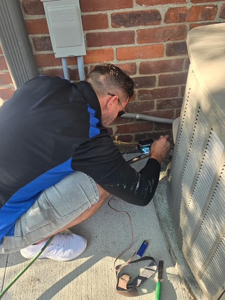
However, there is an important limitation: AI can explain how an HVAC system works, but it cannot inspect or test the equipment inside your home.
It cannot measure airflow, test electrical components, check refrigerant pressures, inspect your heat exchanger, evaluate your ductwork, or determine why one bedroom is consistently hotter or colder than the rest of the house.
AI can help you become a better-informed homeowner. It cannot replace a qualified HVAC technician performing an in-person diagnostic evaluation.
AI Can Suggest Possible Causes, but It Cannot Diagnose the Problem
When homeowners in Fishers, Noblesville, Carmel, Westfield, or another Hamilton County community experience an HVAC problem, they often begin by entering the symptoms into a search engine or AI chatbot:
- “My AC is running but not cooling.”
- “My furnace turns on and shuts off after a few minutes.”
- “The thermostat says cooling, but nothing is happening.”
- “The outdoor unit is making a loud noise.”
- “My breaker keeps tripping.”
- “My upstairs is always warmer than the main floor.”
- “My house feels humid even though the AC is running.”
AI can produce a list of potential causes. For example, an air conditioner blowing warm air could be caused by a dirty filter, frozen evaporator coil, failed capacitor, refrigerant leak, thermostat problem, restricted airflow, electrical failure, or compressor issue.
That list may be helpful, but it is not a diagnosis.
A proper diagnosis requires narrowing the possibilities through testing. A technician may need to put a meter on the capacitor, measure motor amperage, inspect the evaporator coil, test the low-voltage circuit, evaluate refrigerant conditions, and measure the system’s airflow.
AI cannot perform any of those tests. It can only make suggestions based on the information entered by the homeowner—and many HVAC problems produce very similar symptoms.
AI Cannot Evaluate Your Home
Every home is different, and the HVAC equipment is only one part of the comfort system.
Homes throughout Fishers and Hamilton County can have very different construction, layouts, insulation levels, duct designs, and comfort challenges.
For example:
- A two-story Fishers home may struggle with hot upstairs bedrooms during the summer.
- An older Noblesville home may have aging ductwork, inadequate return air, or poor insulation.
- A larger Carmel home may have multiple HVAC systems, zoning controls, high ceilings, or extensive windows.
- A newer Westfield home may still experience uneven temperatures because of equipment sizing or duct-design issues.
- A home with a finished basement may have very different heating and cooling requirements on each level.
- Equipment installed in a tight attic, crawlspace, or mechanical closet may be much more difficult to inspect and repair.
A technician also considers details that may not appear in an online conversation:
- Whether the home has pets, children, or allergy concerns
- Whether filters are being changed regularly
- Whether supply registers or return grilles are blocked
- Whether the ductwork is leaking, damaged, or improperly sized
- Whether rooms are being used differently than originally intended
- Whether the home has had additions, remodeling, or insulation upgrades
- Whether the problem involves temperature, humidity, airflow, or indoor air quality
- Whether the equipment was installed and sized correctly
Even when a homeowner provides these details to AI, AI cannot confirm them. A trained technician can walk through the home, inspect the system, take measurements, and determine how the equipment and house are working together.
HVAC Diagnosis Depends on Real Measurements
Professional HVAC diagnosis is based on testing—not guessing.
Depending on the problem, a technician may need to perform:
- Capacitor testing
- Voltage and low-voltage circuit testing
- Motor and compressor amperage testing
- Temperature-split measurements
- Static-pressure and airflow testing
- Refrigerant diagnostics and leak detection
- Thermostat and control-board testing
- Blower-motor evaluation
- Heat-exchanger and combustion-safety inspections
- Drain-line, condensate-pump, and evaporator-coil inspections
- Ductwork and insulation evaluations
- Manual J load calculations for replacement equipment
AI cannot place a meter on a capacitor or motor. It cannot determine whether a component is operating within the manufacturer’s specifications.
It cannot check whether a furnace is venting correctly, inspect a heat exchanger for potential safety concerns, measure static pressure, or trace an intermittent electrical problem through the low-voltage circuit.
It also cannot determine whether an air conditioner is low on refrigerant. Refrigerant is not normally “used up” during operation. If the system is low, there may be a leak or another issue that needs to be identified. Simply assuming the system needs refrigerant can lead to an incomplete and temporary repair.
The same principle applies to airflow. Restricted airflow can reduce comfort, increase energy use, freeze the evaporator coil, and shorten equipment life. Determining the cause may require inspecting the filter, blower, coil, return ductwork, supply ducts, dampers, and registers.
That work requires someone physically standing in front of the system with the proper tools.
Indiana Weather Makes Local Experience Important
HVAC advice that ignores location is incomplete.
Central Indiana homes experience humid summers, freezing winter temperatures, rapidly changing weather, severe storms, and wide temperature swings during spring and fall. A system may switch from heating to cooling within a short period, placing different demands on the equipment.
Local conditions can also create specific challenges:
- Summer humidity can make a home uncomfortable even when the thermostat reaches the set temperature.
- Cottonwood, grass clippings, and outdoor debris can restrict airflow through condenser coils.
- Freezing temperatures can expose furnace, heat-pump, drainage, and ventilation problems.
- Storms and power fluctuations can affect capacitors, contactors, control boards, and other electrical components.
- Attic ductwork can experience extreme seasonal temperatures.
- Basements and crawlspaces can contribute to moisture, air-quality, and comfort concerns.
- Older homes may have ductwork or electrical systems that were not designed for modern HVAC equipment.
The correct recommendation for a two-story Fishers home may be different from the solution for an older home near downtown Noblesville or a larger property in Carmel.
Local experience helps a technician understand how homes in Hamilton County are constructed and how the regional climate affects heating and cooling performance.
The Risk of Treating AI Like an HVAC Technician
The biggest concern is not simply that AI may be wrong. It is that AI can sound confident even when it has incomplete information.
That confidence can lead homeowners to make costly or unsafe decisions.
Delaying necessary service
If AI suggests a simple problem, a homeowner may continue resetting the breaker, replacing filters, or repeatedly restarting the equipment.
If the actual problem involves overheating wiring, restricted airflow, a refrigerant leak, a failing motor, or a compressor issue, continuing to operate the system could cause additional damage.
Replacing the wrong component
A homeowner may assume the capacitor is bad because it appears first on a list of possible causes. The actual issue could be a failed contactor, damaged wiring, low-voltage interruption, blower problem, restricted coil, or refrigerant-related condition.
Replacing parts without testing them is not a reliable repair strategy.
Attempting an unsafe DIY repair
HVAC systems contain high voltage, stored electrical energy, refrigerant, natural gas components, combustion equipment, and moving parts.
Capacitors can retain an electrical charge even after power is disconnected. Electrical panels and HVAC disconnects can cause serious injury. Furnace and gas-line work can create fire, carbon-monoxide, and combustion-safety risks.
Homeowners can safely handle basic maintenance such as replacing an accessible filter or keeping vegetation away from the outdoor unit. Electrical, refrigerant, gas, and internal equipment repairs should be left to qualified professionals.
Assuming every estimate includes the same work
Two HVAC estimates may describe very different services.
One price may include diagnostic testing, OEM parts, refrigerant recovery, installation materials, code-related corrections, system commissioning, and a labor warranty. Another may include only the quickest possible component replacement.
AI cannot accurately compare the prices unless it receives the complete scope, equipment information, diagnostic findings, warranty terms, and job conditions.
Confusing information with accountability
AI does not warranty the repair, carry business insurance, schedule a return visit, or answer the phone if the system stops working again.
A reputable local HVAC company is responsible for the diagnosis, repair, workmanship, and customer experience.
Why AI Cannot Provide an Accurate HVAC Repair Price
Homeowners often turn to AI because they want to know what an HVAC repair “should” cost.
Unfortunately, accurate HVAC pricing depends on many variables that an online price range cannot see.
These include:
- The actual cause of the failure
- The time required to properly diagnose the problem
- Equipment brand, model, age, and system type
- OEM versus universal replacement parts
- Local parts availability
- Manufacturer and labor-warranty coverage
- Equipment location and accessibility
- Refrigerant type and quantity
- Required electrical, duct, drainage, or code-related corrections
- Normal business hours versus emergency service
- Technician training and experience
- Insurance, vehicles, diagnostic tools, and operating expenses
- Testing required after the repair
- The company’s responsibility if the problem returns
A capacitor purchased online may appear inexpensive, but the part itself is not the entire service.
The customer is paying for a trained technician to travel to the home, identify the actual problem, install the correct component safely, test the system after the repair, document the work, and stand behind the result.
The cost of a part cannot be directly compared with the price of a professionally diagnosed and completed repair.
Why National HVAC Price Ranges Can Be Misleading
Online articles frequently publish wide repair-price ranges. These numbers can be outdated, based on national averages, or written primarily to attract website traffic.
They usually do not account for your specific equipment or home.
Several factors can significantly affect the price:
System type
A standard single-stage air conditioner, heat pump, variable-speed system, communicating system, ductless mini-split, geothermal system, rooftop unit, and older refrigerant system can require very different parts and diagnostic procedures.
Equipment access
Replacing a component in an open basement may be relatively straightforward. Performing the same repair on equipment in a cramped attic or crawlspace can require considerably more time and labor.
Warranty coverage
A manufacturer may cover the replacement part while the homeowner remains responsible for diagnosis, labor, shipping, refrigerant, and related materials. Registration status and warranty terms can also affect coverage.
Repair quality
One contractor may install an OEM part, inspect related components, test system performance, document the readings, and provide a labor warranty. Another may replace the suspected part with minimal testing.
Those are not necessarily the same repair at two different prices. They may be two substantially different levels of service.
Root-cause testing
The least expensive repair can become the most costly if the reason for the original failure is never identified.
A failed blower motor, for example, could be related to airflow restriction, excessive static pressure, a dirty coil, incorrect motor setup, or another underlying condition. Replacing the motor without addressing the cause could lead to another failure.
Fair pricing should be evaluated according to the diagnosis, complete scope, repair quality, warranty, safety, and accountability—not only the final number.
What AI Can Do Well
AI can still be useful when it is used appropriately.
It can help homeowners understand technical terms such as:
- Capacitor
- Contactor
- Static pressure
- Temperature split
- Refrigerant leak
- Variable-speed blower
- Heat exchanger
- Manual J load calculation
- SEER2 and AFUE ratings
AI can also help organize symptoms before a service appointment or develop questions to ask the technician.
Useful questions may include:
- What specific tests did you perform?
- What readings did you find?
- Did the failed component test outside the manufacturer’s specifications?
- Did you identify an underlying reason for the failure?
- Did you inspect both the indoor and outdoor equipment?
- Did you evaluate airflow and system temperature performance?
- Is the refrigerant low, and if so, was the system checked for a leak?
- Does the price include parts, labor, materials, and warranty coverage?
- Are there any electrical, ductwork, drainage, or safety concerns?
- Would repairing or replacing the system make more financial sense?
AI can also help compare two written estimates by identifying differences in equipment, scope, efficiency ratings, warranties, accessories, electrical work, duct modifications, and other included services.
The important point is that the field measurements and written findings should drive the decision.
How to Use AI Before Calling an HVAC Company
Instead of asking AI to diagnose the system, use it to create a clear symptom summary for the technician.
Write down:
- When the problem started
- Whether the problem is constant or intermittent
- Whether the indoor blower is running
- Whether the outdoor unit is running
- What the thermostat displays
- Whether a breaker has tripped
- When the filter was last changed
- Whether there is water around the indoor equipment
- Whether you hear unusual sounds
- Whether you notice burning, electrical, musty, or gas odors
- Which rooms or levels are affected
- Whether utility bills have recently increased
- Whether the equipment has had recent repairs
- Whether the home has undergone remodeling, insulation, or ductwork changes
This information can shorten the diagnostic process and give the technician a clearer picture of what has been happening.
AI can help you understand the technician’s explanation afterward, but it should not override the results of professional testing.
What a Thorough HVAC Diagnostic Visit Should Include
The exact diagnostic process depends on the complaint, but a cooling-system evaluation may include:
- Confirming thermostat operation
- Inspecting the filter and indoor blower
- Checking the indoor and outdoor coils
- Testing electrical components
- Measuring capacitor performance
- Measuring motor and compressor amperage
- Evaluating refrigerant conditions
- Checking the temperature difference between return and supply air
- Inspecting condensate drainage
- Evaluating airflow
- Looking for visible damage or installation problems
A heating-system evaluation may also include:
- Inspecting ignition and safety controls
- Evaluating flame operation
- Checking furnace venting
- Testing the inducer and blower motors
- Inspecting the heat exchanger when appropriate
- Checking temperature rise
- Testing carbon-monoxide and combustion conditions
- Confirming safe system shutdown and operation
For uneven temperatures or weak airflow, the technician may need to look beyond the equipment and inspect duct sizing, return-air capacity, supply registers, static pressure, insulation, zoning, and overall equipment sizing.
For replacement estimates, a responsible contractor should not automatically install the same size equipment simply because that is what the home currently has. The original system may have been incorrectly sized, or changes to windows, insulation, additions, and finished spaces may have affected the home’s heating and cooling load.
Questions to Ask About an HVAC Repair Price
If you are concerned about a repair estimate, ask the contractor:
- What failed, and how did you confirm it?
- What measurements or readings support the diagnosis?
- Is there another issue that may have caused the part to fail?
- Does the price include all labor and materials?
- Is the replacement part OEM or universal?
- What warranty is included?
- Are refrigerant, electrical, drainage, or ductwork corrections required?
- Will the system be tested after the repair?
- Are there other repair options?
- Based on the system’s age and condition, does the repair make financial sense?
A professional HVAC company should be able to explain the problem, available options, complete price, and warranty in understandable language.
A higher price is not automatically unfair, just as a lower price is not automatically a better value. The quality of the diagnosis, repair, parts, testing, warranty, and accountability all matter.
Local HVAC Service for Fishers and Hamilton County
Varsity Zone HVAC of Fishers provides heating, air-conditioning, indoor-air-quality, and HVAC maintenance services throughout Fishers, Noblesville, Carmel, Westfield, and surrounding Hamilton County communities.
Our approach is based on actual testing, clear communication, transparent options, and practical recommendations. We want homeowners to understand what is wrong, how we identified it, what their options are, and what the complete repair will cost before work begins.
AI can help you prepare for that conversation. It cannot replace the technician taking measurements inside your home.
The Bottom Line: Use AI to Learn, Not to Diagnose
Artificial intelligence is useful for explaining HVAC terminology, organizing symptoms, preparing questions, and reviewing written estimates.
It cannot inspect your home, test the equipment, measure airflow, locate a refrigerant leak, evaluate electrical safety, inspect a heat exchanger, calculate the heating and cooling load, or determine whether a quoted price accurately reflects the work required.
Your HVAC system is physical, your home is unique, and every repair has its own circumstances.
Use AI to become an informed customer. Then rely on a qualified local HVAC professional to collect real measurements, identify the actual problem, explain the available options, and complete the repair safely.
When your heating or cooling system is not performing correctly, Varsity Zone HVAC of Fishers is ready to provide real diagnostics and clear answers—not guesses based on a chatbot conversation.
Frequently Asked Questions
Can AI tell me what is wrong with my air conditioner or furnace?
AI can list potential causes based on the symptoms you describe. It cannot confirm the actual failure because that requires inspecting and testing the system. Treat AI’s answer as general education, not a final diagnosis.
Can AI tell me whether an HVAC repair quote is fair?
AI can help compare the written scope of multiple estimates, but it cannot determine a fair price without knowing the diagnostic findings, equipment information, accessibility, parts, warranty, local labor requirements, and complete repair scope.
Is it safe to repair my HVAC system using AI instructions?
Basic homeowner maintenance, such as replacing an accessible air filter, may be appropriate. Repairs involving electricity, capacitors, refrigerant, natural gas, combustion equipment, or internal components can be dangerous and should be performed by a qualified professional.
Why is my air conditioner blowing warm air?
Possible causes include a dirty filter, frozen coil, failed capacitor, thermostat issue, electrical failure, restricted airflow, refrigerant leak, or compressor problem. Because several failures can create the same symptom, the system must be tested to identify the actual cause.
Why does my furnace start and then shut off?
Possible causes include restricted airflow, a dirty flame sensor, thermostat problems, overheating, pressure-switch issues, venting problems, or a failing control component. A technician should test the system and its safety controls before recommending a repair.
Does low refrigerant mean my AC has a leak?
In most cases, an air-conditioning system should not consume refrigerant during normal operation. A low charge can indicate a leak or an installation or charging issue. The cause should be investigated instead of automatically adding more refrigerant.
What is a Manual J load calculation?
Manual J is a recognized method for calculating a home’s heating and cooling requirements. It considers factors such as square footage, insulation, windows, orientation, occupancy, and construction. It helps prevent installing equipment that is too large or too small for the home.
How often should I change my HVAC filter in Central Indiana?
Many standard one-inch filters need replacement approximately every 30 to 90 days, but the correct schedule depends on the filter, system runtime, pets, allergies, household activity, and indoor-air conditions. Check the filter regularly and follow the equipment and filter manufacturer’s recommendations.
Should I repair or replace my HVAC system?
The answer depends on the system’s age, condition, efficiency, repair history, warranty status, refrigerant type, and the cost and expected life of the repair. A properly tested system may only need one reasonable repair, while an aging system with repeated failures may be a better candidate for replacement.
What areas does Varsity Zone HVAC of Fishers serve?
Varsity Zone HVAC of Fishers serves homeowners and businesses in Fishers, Noblesville, Carmel, Westfield, and surrounding communities throughout Hamilton County, Indiana.
For professional HVAC diagnostics, repair options, or a second opinion, contact Varsity Zone HVAC of Fishers.