
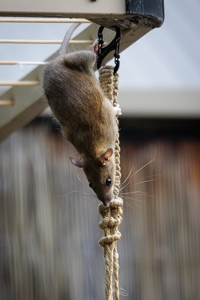
Roof rats return to the local news every fall, and the timing is not an accident. Maricopa County Environmental Services states that roof rats thrive in cool weather and are most active from November through May, that they spend most of their lives four feet or more off the ground, and that attics appeal to them because an attic offers a safe refuge, a nesting place for their young, and routes into the home below. The County lists wood, plastic, aluminum siding, sheet rock, and soft metals among the materials they chew through, and its list of the water sources that draw them includes the drip line from an air conditioner. Pack rats, the native woodrats of the desert edges, work the other end of the system. The University of Arizona Cooperative Extension reports that woodrats nest in attics, garages, and the engine compartments of seldom-driven cars, and that they gnaw on the vinyl or plastic shielding of electrical wires.
A heating and cooling system is built from the materials on those lists. Flexible ductwork is a plastic jacket over fiberglass insulation; thermostat wiring is copper under a plastic sheath; the condensate drain is a PVC pipe with water in it; the line set that carries refrigerant from the outdoor unit to the attic passes through a hole in the house. The sections below explain which rodent is which, where each one is found, how they reach the system, what they do to each part of it, and the order in which a pest control company and an HVAC contractor should take up the work.
Which Rodent You Have
The County’s identification page compares the two. A roof rat has a head and body of seven to eight inches, a scaly, dark tail longer than the head and body combined, large and nearly naked ears, and a pointed snout; its droppings are pointed, banana shaped, and a quarter to a half inch long. A pack rat, which the County lists as a wood rat, has a hairy, bicolored tail about as long as its head and body, large hairy ears, a blunt snout, and blunt droppings a half inch to three quarters of an inch long. Roof rats are an Old World species, as the Town of Paradise Valley notes on its own roof rat page; pack rats are native, and the University of Arizona’s Yavapai County office states that woodrats are not legally protected in Arizona, so homeowners may control them without first contacting wildlife officials.
The distinction decides where to look. The University of Arizona describes roof rats as an arboreal species and agile climbers that prefer to nest in secluded areas above ground, in attics, soffits, and the crowns of palm trees where old fronds are not removed, and it states that sounds in the attic are often the first indication of their presence in a residence. The University’s pack rat guidance says their dens are common at the bases of cholla cactus, that they will sometimes move opportunistically into the attics and walls of houses, and that their middens are common breeding sites for kissing bugs. A roof rat problem usually starts in the trees and ends in the attic; a pack rat problem usually starts in the desert landscaping and ends inside the outdoor unit.
Where They Are in the Valley
Roof rats were first found in the Arcadia district in 2002 and had spread across the Valley by 2004, according to FOX 10. A County vector control official told KTAR in 2012 that Arcadia, central Phoenix, and Ahwatukee tend to have considerable activity, most of it tied to older citrus plantings, and by 2016 Maricopa County Environmental Services was describing the rats to KJZZ as a countywide problem. In January 2025, a pest control operator told ABC15, in a report from Chandler, that the East Valley had seen a major rise in roof rat populations and service calls, that rats were also coming up through sewers, and that neighborhoods with multiple fruit trees and homes with pools were especially vulnerable. The City of Mesa adds four points: the presence of roof rats is not a sign of neighborhood decline, they are not spreading block by block across the Valley, they can arrive unknowingly in moving boxes, and they settle in neighborhoods that meet their needs.
In our service area, the neighborhoods that fit the County’s description are the mature citrus and palm neighborhoods: Arcadia and east Phoenix in 85018, central Phoenix, the older sections of Scottsdale and Tempe, Paradise Valley, and the established parts of Mesa and Chandler. Pack rats belong to the desert edges: the foothills of north Scottsdale and Fountain Hills, the washes of Paradise Valley, and the San Tan side of Queen Creek, wherever cholla, mesquite, and native landscaping meet a house and its outdoor unit.
How Rodents Reach the System
Roof rats travel along power lines, trees, oleanders, vines, and roofs, and the County says they enter homes through any opening larger than a nickel; the University of Arizona’s roof rat handout puts the opening at the size of a dime. Three routes lead to the heating and cooling system.
The line set
The refrigerant lines from the outdoor unit run up the wall inside a cover and pass through the wall or the roof into the attic. The County’s guidance on this point is specific: stuff the cover of the air conditioning line that runs from the outside unit into the attic with steel wool or copper mesh, so that rats cannot climb the insulated pipe inside the cover, and look for scratch marks on the insulation, which show that the route is in use. An unsealed line set cover is a sheltered route from the ground to the attic, and the hole where the lines enter the house is usually larger than a nickel.
The roof
Roof rats travel power lines to trees and roofs, and the sealing guidance that the County and the City of Tempe both publish calls for screening and sealing every hole and vent that leads into the home, including the sewer stacks on the roof. The University of California’s statewide pest management program recommends removing overhanging tree limbs within six feet of roofs and covering rooftop plumbing vents more than two inches across with screens. A rooftop package unit sits among those penetrations, with its supply and return ducts passing through the roof deck beside it.
The attic
Once inside, the County says, rats follow pipes down from the attic and gnaw through sheet rock to reach kitchen and sink cabinets. The air handler or furnace, its ductwork, its drain, and its control wiring are in the attic with them, in the space the County describes as a refuge and a nesting place.
What They Do to the System
Flexible ductwork
Most Valley attics are ducted with flexible duct. A representative residential product, the Thermaflex Flex-Vent KPE, is built from a polyester film core laminated around a steel wire helix, a blanket of fiberglass insulation, and a scrim-reinforced polyester jacket. Nothing in that assembly resists a rodent that chews through plastic and aluminum siding. Roof rats tear up insulation for nesting material, as the University of Arizona reports, and a duct that has been opened for nesting leaks conditioned air into the attic and, on the return side, pulls attic air, dust, and droppings into the airstream. ENERGY STAR estimates that about 20 to 30 percent of the air that moves through a typical duct system is already lost to leaks, holes, and poorly connected ducts, and it lists ducts located in an attic and tangled or kinked flexible ducts among the signs of duct problems; rodent damage is added on top of that baseline.
Low-voltage control wiring
The thermostat communicates with the indoor and outdoor units over a thin multi-conductor cable with a plastic sheath, and that cable crosses the attic and runs down the wall to the outdoor unit. The County lists damage to the plastic coverings on electrical wires among the signs of roof rat activity, and the University of Arizona warns that gnawing on wires poses a fire hazard. On the control side, the symptoms are a system that stops responding to the thermostat, an outdoor unit that runs when it should not or will not start when it should, or a fuse on the control board that fails again after it is replaced; a bare conductor touching another one in the attic produces all three. The University does not say which wiring; on a heating and cooling system, the line-voltage wiring that feeds the furnace, the air handler, and the outdoor unit carries that risk.
Condensate drains and drain pans
The University of Arizona reports that roof rats can gnaw through lead or PVC drain pipes to reach water, and the condensation drip line from an air conditioner is on the County’s list of what attracts them. An attic air handler produces condensate every hour it runs in summer, and the drain that carries the water away is a PVC pipe. A gnawed drain line releases that water onto the ceiling below, and a float switch in the drain pan, where one is installed, shuts the system down until the drain is repaired. A secondary drain pan that holds standing water is one more of the water sources the County describes.
The air handler, the furnace, and the return
The cabinet in the attic has openings that a nickel passes through: the filter rack, the seams between panels, the knockouts where wiring and the drain enter, and, in many older Valley homes, a return built as an open platform under the air handler rather than as a sealed duct. A rat inside the blower compartment leaves droppings on the blower wheel and the evaporator coil, and the return air then carries what it leaves into every room; the CDC treats evidence that rodents have reached a home’s heating and cooling ventilation system as the point at which a professional rodent exterminating service should be called. A gas furnace adds the burner compartment, where a nest blocks the air the burners need.
The outdoor unit
Pack rats treat a condenser the way the University of Arizona says they treat the engine compartment of a car that is seldom driven: as a sheltered cavity with wiring to chew. A condenser cabinet opened after a pack rat has moved in holds a midden of cholla joints, twigs, and insulation packed around the compressor, with the wires to the contactor and the capacitor stripped bare. The nest blocks airflow through the coil, which raises operating cost; the stripped wiring trips the breaker or burns the contactor; and the urine corrodes the aluminum fins and the copper where it sits. The foam insulation on the larger refrigerant line, which keeps the refrigerant cold on its way to the house, is chewed off in lengths, and the bare line then sweats and loses capacity through the summer.
Rooftop package units
Package units on Valley roofs are reached by the route the County describes, from the power line to the tree to the roof. The unit’s supply and return ducts pass through the roof deck on a curb, and the gaps where the duct meets the curb, the openings at the fresh-air hood, and the seams where the cabinet panels meet are the openings rodents use. Rats inside a package unit nest against the compressor and in the return plenum, and the odor arrives through the supply registers on the first cool morning the heat comes on.
The Signs, in the Order They Usually Appear
- Noises above the ceiling or inside the walls after dark, which the University of Arizona says are often the first indication of roof rats in a residence.
- Hollowed-out citrus on the tree or under it, and rats seen on power lines, in trees, or on patios at dusk.
- Gnaw marks around the roof eaves, and scratch marks on the insulation inside the line set cover.
- Droppings in the attic, on top of the air handler, or at a register, in the shapes the County’s identification page describes.
- An odor at the registers that is strongest in the first minutes after the system starts.
- A thermostat that loses contact with the system, an outdoor unit that will not start, or a control fuse that fails repeatedly.
- Rooms that cool unevenly and a higher bill, which ENERGY STAR lists among the signs of duct problems, and dust at the registers.
- A float switch that shuts the system down, or a wet spot on the ceiling under the attic air handler.
- Pets that stare at the ceiling or a wall, which the County lists as unsettled pets.
Who Does What, and in Which Order
Arizona regulates pest control through the Pest Management Division of the Arizona Department of Agriculture, which requires a business license of anyone engaging in, offering to engage in, advertising for, soliciting, or performing pest management, and which provides a business license search and a complaint history search. Varsity Zone is an HVAC contractor, not a pest control company. The rodents belong to the pest company, the system belongs to us, and the order of the work matters, because ductwork repaired before the entry points are sealed will be repaired twice. The University of Arizona states that exclusion and barriers are the most effective management methods when woodrats are entering structures, and the same principle governs roof rats.
The sequence that works is this:
- Exclusion and removal first. A licensed pest control company finds and seals the entry points, removes the rodents, and tells you when the house is closed. Maricopa County Vector Control investigates roof rat complaints to determine the responsible party; it does not provide bait stations or traps.
- Assessment of the system. The checks on our 40-plus point inspection are the ones that find rodent damage: the ductwork and plenums are inspected for air leaks, the blower and the evaporator coil are checked for cleanliness, the safety drain switch and the drain pans are verified, and, at the outdoor unit, the contactor, the capacitor, the condenser fan motor and blade, the service disconnect, and the electrical whip are checked and the overall condition of the unit is documented. A chewed duct jacket is an air leak; a nest in the blower compartment is a cleanliness finding; stripped wiring at the contactor is an electrical finding.
- Repair. The findings decide the repair. Ductwork and plenums that leak are repaired, sealed, or replaced, which is the work our air duct services page describes; connections are sealed with mastic or metal tape, which ENERGY STAR recommends, and never with duct tape, which ENERGY STAR says is not long-lasting. Electrical parts with rodent damage are replaced, and a drain switch or a drain pan that no longer works is put right. Sealing the line set cover and the penetration behind it, screening the rooftop vents, and closing the other entry points belong to the pest company’s exclusion work; the County advises packing the line set cover with steel wool or copper mesh, and the University of California recommends galvanized metal mesh over vent openings rather than chicken wire, which it says rats pass through.
- Cleaning by the CDC’s rules. The CDC says to open doors and windows for 30 minutes before cleaning, to wear rubber or plastic gloves, not to vacuum or sweep rodent urine, droppings, or nesting materials, to soak them with a disinfectant or a bleach solution of one part bleach to nine parts water for five minutes before wiping them up, and to bag contaminated insulation in plastic for removal. Contaminated blown-in attic insulation is bagged for removal, as the CDC describes, and an attic with a heavy infestation calls for the respirator-grade protective equipment the CDC specifies for that work, which in practice means a professional crew rather than a homeowner with a dust mask.
- The trees and the yard come last, and the prevention section below covers them.
Why October Through April Is the Window
The County’s roof rat season, November through May, overlaps the months when a Valley attic is workable, October into April, so the rodent season and the inspection season are largely the same months. Attics in July are too hot for an hour of careful work, which is why duct damage done during a winter nesting season is often found at a July service call, after the system has been losing air into the attic for months. A fall maintenance visit under the Season Ticket Maintenance Plan includes the air leak, cleanliness, and outdoor unit checks described above, so a chewed duct jacket or a nest in the blower housing is found while the fix is still a morning’s work. Duct replacement and sealing scheduled now is finished before the first hot day, and our Off-Season Advantage article covers the scheduling and pricing side of fall work.
Keeping Them Out
The pest company handles the active infestation; what keeps the next one away is on the homeowner’s side of the fence, and the County, the cities, and the University of Arizona agree on the list.
- Seal the openings. The County advises stucco diamond mesh around vents, water heaters, laundry appliances, dishwashers, and under sinks, screens on roof sewer stacks, caulk in cracks, and steel wool or copper mesh in the air conditioning line cover. The University of California recommends sealing openings around pipes, cables, and wires that enter through walls or the foundation, and sealing every hole larger than a quarter inch.
- Trim the trees. The University of California’s figure is six feet for overhanging limbs, and the University of Arizona’s rule is that branches should not touch walls and roof lines. Tempe notes that the trees with the most activity are the ones touching other trees, houses, fences, or power lines, and that roof rats nest in the skirts of old palm fronds.
- Harvest the citrus promptly and completely, and pick up fallen fruit, as Tempe and Paradise Valley both advise. The University of Arizona notes that research shows roof rat populations are not tied to the availability of food plants, so removing the trees will not remove the rats; harvesting the fruit removes a reason to visit.
- Store pet food, bird seed, and bulk food in sealed containers, do not leave pet food out overnight, and keep garbage lids closed.
- Keep wood and lumber piles at least 18 inches above the ground and 12 inches from walls, remove brush piles, rake under trees and shrubs, and thin bushes until daylight shows through them, per Tempe’s roof rat information page. Paradise Valley adds a point for homeowners with landscapers: do not let cuttings and clippings from other customers’ properties be brought onto yours, since rats move in hauled trimmings.
- Fix standing water. Leaky faucets, sprinkler heads, bird baths, saucers under pots, and pet dishes are on the County’s list, and so is the condensate drip line. A condensate line that terminates in a puddle beside the outdoor unit should be extended to a drain or a dry location.
- For pack rats, remove the middens. The University of Arizona’s conenose bug guidance advises having pack rat nests within 300 feet of the home removed, because kissing bugs breed in them, and its woodrat guidance says to soak a nest with an antibacterial and antiviral disinfectant before disturbing it. Keep cholla and prickly pear away from the condenser pad, and keep the pad clear of debris.
- Use the city for the trimmings. Phoenix collects bulk trash by appointment, with tree trimmings cut under 12 inches in diameter and 4 feet in length; Scottsdale runs a monthly brush and bulk collection with limbs cut to 6 feet; Chandler schedules curbside bulk collection by phone or online form and takes tree trimmings cut to 5 feet; Queen Creek schedules bulk trash collection by address; Fountain Hills contracts with Republic Services for residential and bulk trash collection; and Mesa, Tempe, and Paradise Valley each maintain the roof rat pages linked above.
Frequently Asked Questions
I hear scratching above the bedroom at night. Could it be the air conditioner?
Scratching that starts after dark, moves across the ceiling, and stops when a light goes on is not the equipment. System noises follow the thermostat: a blower starts and stops on a cycle, a duct pops as it warms or cools, and a loose panel rattles only while the unit runs. Call a licensed pest control company first, and ask us to inspect the ducts and wiring once the entry points are sealed.
Do roof rats carry disease?
Maricopa County reports that roof rats throughout the county continue to be tested for tularemia, hantavirus, and plague, and that all tests to date have been negative. The University of Arizona lists several diseases that roof rats may transmit, and it treats pack rat nests with particular caution, as the question about outdoor units below explains. The CDC’s cleanup rules apply to every nest and every pile of droppings regardless of species.
Can the ducts be cleaned instead of replaced?
Sheet metal trunk lines and plenums can be cleaned and sealed. Flexible duct that rodents have nested in or traveled through is replaced, because the fiberglass insulation and the plastic core cannot be disinfected in place and a jacket that has been chewed open no longer holds air. Our air duct services page describes the duct repair, replacement, and sealing work that follows the pest company’s. Our Valley Fever article explains what a filter can and cannot do about the particles that remain in the airstream afterward.
Will poison in the attic solve the problem?
Not by itself. The University of Arizona cautions that rodenticides are designed to kill mammals and may pose a significant risk to non-target mammals, including people, and the University of California warns that a single dead rodent may be enough to poison a pet. Tempe’s roof rat information page makes the point directly: the home must be sealed first, so that a poisoned rat does not enter the house and die there, creating an odor that may be hard to remove; a rat that dies inside a duct or a return platform cannot be removed without opening the duct. Paradise Valley’s guidance is to use only products labeled for rats, to follow the label, and to place baits where children, pets, and non-target animals are protected; the County’s guidance for the line set cover is to watch the insulation for scratch marks and set a snap trap at that entrance. Exclusion is the part that lasts.
The smell is coming out of the vents. What does that mean?
An odor that is strongest when the system starts and fades as it runs usually means a nest or a dead rodent in the return side, the air handler, or a supply duct, and the airstream is carrying it. A soiled blower wheel and coil produce a fainter version of the same odor every time the blower starts. The fix is to locate the source with the panels open, remove it by the CDC’s rules, clean the blower and the coil, and replace the duct section involved. Running the fan to clear the smell spreads it.
Is the line set cover really a way in?
Yes. The County’s guidance names it directly, as described earlier in this article. The cover is a vertical tunnel with a foam-wrapped pipe inside it and a hole at the top, and it was installed to protect the lines from sun and weather, not to keep anything out. Sealing the top of the cover and the penetration behind it is a small job, and it belongs on the pest company’s exclusion list.
There is a nest inside my outdoor unit. Can I hose it out myself?
Turn the power off at the disconnect before anything else. The University of Arizona says never to handle dead or dying woodrats with bare hands, that hantavirus and other zoonotic diseases can be present in woodrat nests, and that kissing bugs breed in pack rat middens, so the nest is soaked with disinfectant and removed with gloves, not sprayed out with a hose. The wiring inside the cabinet has usually been chewed, and water driven into the contactor, the capacitor, or the control wiring creates a second problem. Once the nest is out, the wiring inside the cabinet needs inspection and repair before the unit is restarted; the contactor, the capacitor, and the electrical connections at the unit are on the outdoor unit checklist for that reason.
Does a maintenance visit check for rodents?
Rodents are not a line item on our 40-plus point inspection, but several of its items find what they leave behind: the air leak inspection of the ductwork and plenums, the cleanliness checks on the blower and the evaporator coil, the drain switch and drain pan checks, and the electrical checks at the outdoor unit, with the findings documented. The visit does not replace the pest company; it tells you if one is needed, and it catches duct and wiring damage before the first hot day.
Will a home inspection catch rodent damage to the ducts?
Not necessarily. Arizona’s home inspection standard does not require the inspector to report on the presence or absence of pests, and it does not require the inspector to enter an attic where access is obstructed or entry is unsafe. Our home buyer article explains what the standard covers and how to fit a licensed HVAC evaluation into the inspection period; for a home in a citrus neighborhood, that evaluation should include the attic ducts from inside the attic.
Before the Next Cool Night
Rodents do not damage a heating and cooling system in a single night; they work on it through a season, and the bill arrives in summer. Varsity Zone HVAC of Scottsdale repairs, seals, and replaces ductwork, repairs and replaces air conditioners, heat pumps, and furnaces, including systems damaged by rodents, and keeps systems in service through the Season Ticket Maintenance Plan, for homeowners in Scottsdale, Paradise Valley, Fountain Hills, Phoenix, Tempe, Mesa, Chandler, and Queen Creek. We install Trane, Bosch, Lennox, Daikin, and Goodman equipment, and our ductwork and fittings come from AC Pro. To schedule a fall inspection, call our office at 480-590-4647 or book online.
Photos: roof rat on a rope and roof rat on a wall by Andrew Arch, via Flickr, licensed under CC BY 2.0; the first cropped and extended at the sides.