
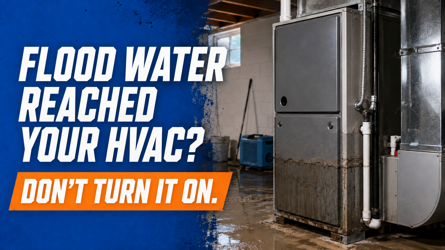
Historic flooding has affected homes and businesses throughout Noblesville, Carmel, Fishers, and Hamilton County, leaving many property owners wondering whether their furnaces, air conditioners, heat pumps, water heaters, and ductwork are still safe to operate.
The White River reached a record 24.6 feet in Noblesville, surpassing a record that had stood since 1913. Flooding forced evacuations, damaged homes, caused power outages, and led Carmel, Fishers, and Noblesville to declare states of emergency. (WRTV)
If floodwater reached any portion of your HVAC equipment, do not assume it is safe simply because the water has receded. Electrical controls, gas valves, motors, insulation, safety switches, and other internal components can remain damaged or contaminated long after the outside of the unit appears dry.
The Most Important Rule: Do Not Turn It On
If floodwater reached your furnace, air handler, heat pump, air conditioner, water heater, boiler, or associated electrical components, do not turn the equipment on.
Attempting to operate flood-damaged HVAC equipment can create several serious risks:
- Electrical shock or fire
- Shorted motors and control boards
- Damaged gas valves or ignition controls
- Carbon monoxide or combustion-gas leaks
- Additional damage to equipment that may otherwise have been evaluated
- Mold, bacteria, sewage residue, or other contaminants circulating through your home
If the electrical panel and surrounding area are completely dry and safely accessible, turn off the HVAC system at the breaker. Never enter standing water or touch wet electrical equipment to reach a disconnect or breaker. Contact the utility company, fire department, or a qualified professional if there is any question about safety.
What HVAC Equipment Should Be Inspected After a Flood?
Arrange for a professional HVAC flood-damage inspection if water reached or came close to any of the following:
- Furnace or air handler
- Indoor evaporator coil
- Outdoor air conditioner or heat-pump condenser
- Control boards and electrical connections
- Blower motor
- Gas valve and ignition system
- Furnace or boiler venting
- Ductwork and duct insulation
- Thermostat wiring
- Whole-home humidifier or air purifier
- Water heater
- Sump-pump-related electrical equipment
Even brief contact with floodwater can damage sensitive electrical and safety components. Corrosion may begin inside a control or gas valve where it cannot be seen during a basic visual inspection.
Can a Flooded Furnace Be Repaired?
In many cases, a furnace that has been partially or completely submerged should be replaced instead of repaired.
Gas furnaces contain valves, burners, ignition components, pressure switches, motors, circuit boards, and safety controls. Floodwater may carry mud, sewage, chemicals, and corrosive material into these components. Cleaning the outside of the furnace does not remove contamination or corrosion inside sealed controls.
The Air-Conditioning, Heating, and Refrigeration Institute recommends replacing flood-damaged heating and cooling equipment rather than attempting repairs. All inspections and replacements should be performed by qualified HVAC professionals. (AHRI flood-damaged HVAC guidance)
A qualified technician should document:
- The highest visible water line
- Which components contacted floodwater
- Electrical and gas-control damage
- Contamination inside the cabinet
- Equipment model and serial numbers
- Estimated repair or replacement cost
- Whether the system can be operated safely
This documentation may be helpful when submitting a homeowners or flood-insurance claim.
What About an Outdoor Air Conditioner or Heat Pump?
Outdoor equipment is designed to withstand normal rain, but it is not designed to operate while submerged in floodwater.
An air conditioner or heat pump needs professional evaluation if floodwater:
- Reached electrical controls or wiring
- Covered part of the compressor
- Deposited mud or debris inside the cabinet
- Shifted the unit or condenser pad
- Bent or damaged refrigerant lines
- Caused the equipment to tip or move
- Reached the outdoor disconnect
Even a small movement can damage refrigerant lines or electrical connections. Do not try to straighten, clean, or restart the unit yourself.
Flooded Ductwork Can Affect Indoor Air Quality
Floodwater can introduce bacteria, sewage residue, mold spores, chemicals, and other contaminants into ductwork.
Any fiberglass duct board, flex duct, internal duct liner, or duct insulation that contacted floodwater will generally need to be removed and replaced because porous insulation cannot be reliably cleaned and disinfected.
Metal ductwork may sometimes be cleaned, dried, and disinfected, depending on its condition and accessibility. The entire affected system should be evaluated before the blower is operated. Turning on the HVAC system too soon could distribute contaminants throughout the house.
Flood-Damaged Water Heaters Should Usually Be Replaced
Floodwater can damage gas valves, burners, thermostats, heating elements, wiring, safety devices, and the insulation surrounding a water-heater tank.
Even if a flooded water heater appears to work, hidden corrosion can lead to future safety and reliability problems. AHRI recommends replacing water heaters that have been exposed to floodwater.
Do not attempt to relight a flooded gas water heater or restore power to a flooded electric water heater.
What to Do Before an HVAC Technician Arrives
Take the following steps only when the affected area is safe to enter:
- Do not operate the HVAC system.
- Photograph the equipment and visible water line before cleanup begins.
- Record model and serial numbers if they are safely accessible.
- Photograph damaged ductwork, wiring, disconnects, and surrounding areas.
- Create a list of every mechanical appliance exposed to water.
- Contact your insurance company and ask what documentation it requires.
- Keep damaged equipment until your insurance adjuster authorizes its removal.
- Schedule an inspection with a qualified HVAC contractor.
Do not discard equipment or damaged components prematurely. Your insurance company may want to inspect them or review photographs and a written contractor’s report.
Does Homeowners Insurance Cover Flood-Damaged HVAC Equipment?
Coverage depends on the source of the water and the specific language in your policy.
Standard homeowners insurance often treats rising groundwater differently from water caused by a covered plumbing failure, wind-driven rain, or storm-related electrical surge. A separate flood-insurance policy may apply when damage is caused by rising surface water.
Contact your insurance agent or adjuster as soon as possible. Ask whether the company requires:
- Photographs of the water line and equipment
- A professional HVAC inspection
- Written confirmation that the equipment is unsafe
- Repair and replacement estimates
- Model and serial numbers
- Proof of the equipment’s approximate age
- Damaged components to be retained for inspection
Varsity Zone HVAC can provide findings and equipment information to help homeowners document HVAC damage. Final coverage decisions are made by the insurance company.
HVAC Flood-Damage Help in Noblesville, Carmel and Fishers
If floodwater reached your heating and cooling equipment, do not take the risk of turning it back on without a professional inspection.
Varsity Zone HVAC of Fishers provides HVAC flood-damage inspections for homeowners and businesses throughout Noblesville, Carmel, Fishers, Westfield, Geist, and Hamilton County.
Our team can evaluate:
- Furnaces and air handlers
- Air conditioners and heat pumps
- Electrical controls and motors
- Gas valves and safety components
- Refrigerant lines and outdoor equipment
- Ductwork and insulation
- Water heaters
- Indoor-air-quality equipment
- Repair-versus-replacement options
- Information needed for an insurance claim
Floodwater Reached Your HVAC? Don’t Turn It On.
Contact Varsity Zone HVAC of Fishers to schedule a professional flood-damage inspection. We will inspect the affected equipment, explain what we find, and help you determine the safest next step for your home or business.
Frequently Asked Questions About Flooded HVAC Equipment
Can I turn on my furnace after the basement dries?
Not until a qualified HVAC technician has inspected it. Internal electrical parts and gas controls can remain damaged even when the furnace looks dry.
Is an outdoor AC unit ruined if floodwater reached it?
Not necessarily, but it should not be operated until it is inspected. The technician must check the compressor, wiring, controls, refrigerant lines, condenser pad, and disconnect.
Can flooded ductwork be cleaned?
Accessible metal ductwork may sometimes be cleaned, dried, and disinfected. Wet fiberglass duct board, flex duct, internal liner, and duct insulation will generally need to be replaced.
Should I photograph my HVAC system for insurance?
Yes. Photograph the water line, the entire unit, model and serial numbers, nearby wiring, ductwork, and all visible damage before equipment is moved or removed.
Who provides HVAC flood-damage inspections near me?
Varsity Zone HVAC serves homeowners and businesses in Fishers, Noblesville, Carmel, Westfield, Geist, and surrounding Hamilton County communities.