
Why Is My Upstairs Always Hot?
You set your thermostat to 72 degrees. The downstairs feels comfortable. But upstairs? It feels like a completely different season. If you've ever lowered the thermostat just to make the second floor tolerable, you're not alone. "My upstairs is always hot" is one of the most common concerns we hear from homeowners throughout Lake Norman and the Charlotte area. The good news is that this problem can often be improved, or even solved entirely. The key is understanding what's causing it.
Heat Naturally Rises, But That's Only Part of the Story
Let's start with a simple fact of physics: heat rises. As warm air accumulates in your home, it naturally moves upward. That's why second floors typically run warmer than first floors, especially during the summer months here in North Carolina.
While some temperature difference between floors is completely normal, large differences are not. If your upstairs feels 5, 8, or even 10 degrees warmer than downstairs, there's usually another issue contributing to the problem beyond simple physics.
The encouraging part? Most of these contributing factors are diagnosable and fixable. Understanding the root cause is the first step toward a more comfortable home, and that's exactly what this guide is designed to help you do.
Common Temperature Gaps Homeowners Report
When our technicians visit homes in the Lake Norman and Charlotte area, these are the most frequently reported upstairs temperature differences:
- 5°F warmer: noticeable but manageable
- 8°F warmer: uncomfortable for sleep and daily living
- 10°F+ warmer: a clear sign of a systemic issue
Your HVAC System May Be Struggling with Airflow
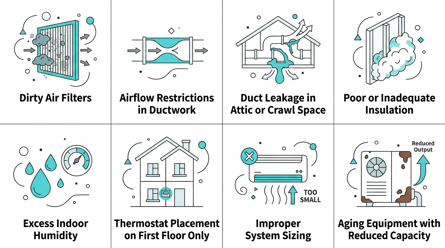
Think of your HVAC system like your body's circulatory system. If blood isn't reaching certain areas efficiently, problems develop. The same is true with conditioned air. Even a high-efficiency HVAC system can't perform properly if the airflow is restricted, and this is one of the most common culprits behind upstairs discomfort.
In many homes, the problem isn't the equipment itself. It's getting enough cool air to the rooms that need it most. Second-floor bedrooms are often at the end of long duct runs, furthest from the air handler, and the least likely to receive adequate airflow when something is off in the system.
Undersized Ductwork:
If the ducts serving your upstairs were never designed to move enough air volume, no amount of thermostat adjustments will fix the problem at the room level.
Closed or Blocked Vents:
Closing vents in unused rooms may seem logical, but it actually disrupts system pressure and can reduce airflow where you need it most.
Dirty Air Filters:
A clogged filter restricts airflow at the source, reducing the volume of conditioned air the system can push through the entire duct network.
Leaky Ductwork:
Duct leaks in attics or crawl spaces allow conditioned air to escape before it ever reaches your living spaces, a silent but significant efficiency killer.
Your Attic Could Be Working Against You

During a North Carolina summer, attic temperatures can exceed 130 degrees Fahrenheit. That's a tremendous amount of heat sitting directly above your second floor. If insulation levels are inadequate or attic ventilation isn't performing properly, that heat transfers into the living space below, and your HVAC system has to work overtime just to keep up.
The relationship between your attic and your upstairs comfort is more direct than most homeowners realize. Think of inadequate insulation as a window left open to that 130-degree air. No matter how hard your air conditioner runs, it's constantly fighting heat intrusion from above.
Signs Your Attic May Be Contributing
- Upstairs gets hottest in late afternoon
- Bedrooms remain warm well into the evening
- HVAC runs constantly but struggles to catch up
Your System May Be Undersized, or Aging
Not every HVAC system was sized correctly when it was installed. Some homes have additions, renovations, or lifestyle changes that increase cooling demands beyond what the original system was designed to handle. Others simply experience the natural decline that comes with age. A system that cooled your home perfectly 12 years ago may genuinely be struggling today.
Reduced Cooling Capacity:
As components wear, the system simply can't move as much heat out of the home as it once did, even running constantly.
Increased Demand from Renovations:
Additions, finished bonus rooms, or converted attic spaces add square footage that the original system was never designed to condition.
Efficiency and Airflow Decline:
Wear on motors, coils, and other components reduces both efficiency and airflow, compounding the upstairs comfort problem over time.
Before investing in a brand-new system, it's worth having a professional evaluate whether your current equipment is truly the limiting factor, or whether airflow, insulation, or duct issues are the real culprits.
The Thermostat Is Usually Downstairs, And That's a Problem
Most homes have a single thermostat located on the first floor. Here's the issue: when the downstairs reaches the desired temperature, the thermostat tells the system to stop running. Meanwhile, the upstairs may still be several degrees warmer. The thermostat simply doesn't know the second floor is uncomfortable, because it isn't measuring the temperature there.
This creates a frustrating loop for homeowners. You lower the thermostat to get upstairs cool enough, but now the downstairs becomes overcooled and uncomfortable. The system runs more than it should, energy bills climb, and the temperature imbalance never fully resolves because the root cause, thermostat placement, hasn't been addressed.
Fortunately, modern technology offers practical solutions that don't require a full system replacement. Smart thermostats with remote sensors can measure temperature in multiple rooms simultaneously, giving the system a more complete picture of your home's actual comfort needs.
Options That Can Help
- Smart thermostats with remote sensors
- Zoned HVAC systems with multiple thermostats
- Air balancing adjustments to redirect airflow

Humidity Makes Everything Feel Worse
Temperature is only part of the comfort equation. Humidity plays a huge role in how your home actually feels, and this is especially true in the Lake Norman and Charlotte area, where summer humidity can be relentless. When indoor humidity rises, rooms feel warmer than the thermostat reads, sleep quality decreases, and the home takes on that sticky, heavy feeling that no amount of air conditioning seems to fix.
Why It Feels Hotter:
High humidity slows the evaporation of sweat from your skin, your body's natural cooling mechanism. When evaporation slows, you feel the heat more intensely even at the same air temperature.
The Thermostat Confusion:
Many homeowners lower their thermostat because they feel warm, but the real issue is excess moisture. Proper HVAC performance addresses both temperature and humidity levels simultaneously.
Sleep and Wellbeing:
Upstairs bedrooms tend to trap humidity, especially at night. Poor humidity control is often behind sleep complaints that homeowners mistakenly attribute to temperature alone.
If your system is oversized for your home, it may be short-cycling, turning on and off too quickly to properly dehumidify the air. This is another reason proper system sizing matters beyond just cooling capacity.
Could a Zoned System Be the Answer?
How Zoning Works
A zoned HVAC system divides your home into independently controlled areas. Each zone has its own thermostat, and motorized dampers in the ductwork direct conditioned air where it's actually needed, not just wherever the duct happens to go.
Instead of treating your entire home as one large, undifferentiated space, zoning responds to the actual comfort demands in each area at any given time.
Potential Benefits
- Better comfort on the second floor
- Lower energy usage overall
- More consistent temperatures throughout
- Reduced hot and cold spots
For some homes, zoning provides one of the most effective solutions to persistent upstairs discomfort. Not every home needs it, and in some cases, simpler fixes like duct sealing or air balancing resolve the problem entirely. But many homeowners are genuinely surprised by how much of a difference a properly designed zoned system can make.
Zoning is particularly worth exploring when the temperature difference between floors is significant, when household schedules create very different usage patterns by floor, or when previous attempts to address the imbalance through equipment alone haven't delivered lasting results.
What Should You Do If Your Upstairs Is Always Hot?
Before assuming you need a new HVAC system, it's important to identify the actual cause of the problem. We've seen upstairs comfort issues stem from a wide range of sources, and guessing often becomes expensive. The solution depends entirely on the diagnosis.
The most important thing you can do is resist the urge to jump straight to solutions. A home that's uncomfortable upstairs because of duct leakage needs a very different fix than one that's uncomfortable because of inadequate insulation or an oversized system. Getting a proper diagnosis first saves time, money, and the frustration of solving the wrong problem.
Need Help Solving an Upstairs Comfort Problem?
At Varsity Zone HVAC, we believe comfort problems deserve real answers, not assumptions and not rushed equipment recommendations. When homeowners tell us their upstairs is always hot, our goal isn't simply to sell something. Our goal is to understand why the problem exists, what's causing the imbalance, and which solutions make the most sense for your specific home and budget.
Sometimes the fix is straightforward, a dirty filter, a blocked vent, or a simple airflow adjustment. Sometimes it's a combination of duct sealing, insulation improvements, humidity control, and equipment tuning. But every effective solution starts with understanding the root cause. That's the commitment we make to every homeowner we serve in the Lake Norman and Charlotte area.
Airflow Evaluation:
We assess ductwork, filters, vents, and system pressure to identify airflow restrictions.
System Performance Check:
We measure actual cooling output and compare it against your home's real demands.
Insulation & Attic Review:
We evaluate attic conditions and insulation levels that may be driving heat into your second floor.
Clear Recommendations:
No pressure. No gimmicks. Just honest answers and practical solutions sized to your home and budget.
If your upstairs feels like a sauna while the downstairs stays comfortable, you're not imagining it, and you don't have to live with it. Our Comfort Diagnostic is designed to give you real answers.
About Carl Steinmann
Carl Steinmann is the owner of Varsity Zone HVAC of Mooresville. With a background in economics, business strategy, and supply chain operations, Carl believes homeowners deserve more than repairs—they deserve education, transparency, and guidance that helps them make smart long-term decisions about comfort, energy efficiency, and protecting their home.